Ad

Wednesday, March 19, 2003

Randall Scott Harden and John Reynolds "Close to Nature" - Hoosier Salon - March 19, 2003 - 3 1/2 stars


The new and without question improved Hoosier Salon Gallery can boast space, better fighting and easier access to the organization. Traditional Indiana landscapes get a color-tinged twist in the works of Harden and Reynolds. Harden's painterly depictions of Power-laden scenes are executed with thick impasto swabs of color impressionistically dabbling his canvases. His picket fence views are less inspired than the nearly biomorphic oil on paper small landscapes. Smooth and shiny, they are abstracted just enough. "Sunlit Givery," with its purples and pinks against green and hints of blue and hot red on the horizon, are a testament to his well-balanced visual talents. John Reynold's many rooster, cow and nature paintings are executed expressively with a cooler color palette and softer hard. Teals and pea greens shadow and highlight his roosters while contrasting vibrantly against the red-red cock's combs. "Hereford at the Fond" is a comparatively tiny piece at 7-inches-by-5-inches. It's a realistic representation of a cow you'd want to know, with streaks of purple reflecting in the white waters, Both artists are excellent and produce quality in their traditional genre. The Hoosier Salon is a prime, and recommended, spot to view and weigh the transition traditional painting is undergoing in Indiana. Through April 12, 2003; 317-253-5340. –Mary Lee Pappas

Jennifer Bartlett "Prophetic Agenda and the Feminine Mystique" - Jarrett Engineering - March 19, 2003 - 1 1/2 stars

(5335 N. Tacoma Ave.). A federal judge ruled in 2001 that Barbie could be parodied by artists it, their work. Since then, artists have much abused this Mattel medium to explore sexuality, female stereotyping and pop American culture. Barbie exploitation is seen so often that it has become pitifully cliched, particularly in contemporary art photography. Just in time for Lent, Bartlett presents a softly focused, dramatically lit Barbie and Ken enacting stories of the Bible and the Apocrypha in this photo series with titles that include "Eve Defies Adam," "Ester Saves the Jews" and "An Adulteress Repents." You need not be a Bible-thumper to be confused by this show. It's a wee bit overwrought with intended symbolism, among other things, to be just goofy. Local photographer Cy McOuigg, who has done comparable doll imagery, does a much better job. Located in the far corner of a smoky old office (you have to weave between work stations to see it), the work is framed really nicely, complete with brass title plates. Not all atypical art venues work (hair salons, for instance) but the staff was gracious and this office had an eclectic charm. Here is a random smattering of national Barbie art photography to peruse: www.geocities.com/micromarty/ADbarbie.htm; http://helios.acomp.usf.edu/~difrey/. Through March 21, 2003. -Mary Lee Pappas

Wednesday, March 12, 2003

Caroline Mecklin - Deano's Vinos - March 12, 2003 - 4 1/2 stars

Mecklin, known for her nudes and portraits, presents an outstanding new body of work. Her approach to painting is so distinguishable and proficient that it is a delight to see her stretch beyond her already high standard of excellence. Everything is polished. In one piece, a pastel lounging woman is framed by the fabrics she lies on - shapes and dashes of bright color surrounded by black. The spontaneous, patterned image advances toward the viewer and conceptualizes reality and the human form. This odalisque is elegant, beautiful and masterful. Another portrait, in charcoal, is inspired. Mecklin's unending artistic examination is demonstrated well here and worthy of note. An artist reception will take place March 21. Through April 4, 2003. –Mary Lee Pappas

Edie Gray - Joe Reuzar's Deli - March 12, 2003 - 2 stars


While the black beans and rice at Reuzar's were delicious, the art on the walls was bland and state. The collection of naive acrylic abstractions lacked technical substance, yet were still expressive, maybe even personal, in their own psychedelic way. Unfortunately, they carried a generic, replicated look. Only "Soul Dance," with its swirly pastel colors, had a more fluid edge. The manipulated photos on display better expressed the artist's aesthetic sensibilities. While the compositional continuity was maintained, the colors were hotter and the warped forms had depth. The work was enhanced by excellent matting and framing. The photos spoke for themselves. 317-916-DELI. -Mary Lee Pappas

Wednesday, March 05, 2003

Me, Myself and I, Self-Portraits - Indianapolis Museum of Art - March 5, 2003 - 3 stars

The collection of self-portraits, from Durer to Rauschenberg, are sensitively conceived representations of the artists’ personalities and serve as valuable documents of art history. Primarily black and white images (etchings, engravings, lithos and drawings) are crisply presented in plain, bleached wood frames with white mats. Ibis enhances the sketchy and intimate feel of the show. Self-portraits are, as the exhibit explains, "artistic exercise” that every artist utilizes to sharpen skills. Aesthetic sensibilities, status and technique are sharpened through these self-studies. They convey what the artist thinks of herself or, in the case of this grouping, mostly himself. George Cruikshank, who illustrated Grimm's fairy tales and Charles Dickens works, represents himself in the same manner as his famed illustrations. A piece by a promising Indiana artist f the late 19th century, Charles David Fiscus, is displayed. One of only two works completed by this artist before his death at the age of 22, it is delicately and masterfully rendered, especially when compared to fellow Herron student Glen Cooper Henshaw’s pompous pose. This is a show (the Goya and Mora pieces are very cool) that artists and students of art history should see and savor. Let's hope this gallery doesn't experience the abnormally high levels of humidity plaguing the Turner Gallery next to it during this wet weather. A renovated facility with more than a mere hygrothermograph can't come soon enough. Through March 9, 2003; 317-923-1331. -Mary Lee Pappas

Wednesday, February 26, 2003

Full Circle: James Willie Faust - Domont Studio Gallery - Feb. 26, 2003


Full circle: James Willie Faust
Visual Arts Review | Thru March 22
Mary Lee Pappas

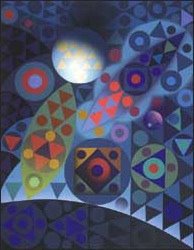
*Pictured: "Auspicious Night" by James Wille Faust

John Domont speaks articulately and poetically for the art he represents at his Domont Studio Gallery. His words are coup for gallery hopper James Wille Faust, who has settled at Domont for his first solo show in three years. Simply said, the paintings are more of the same - more rote than ripe. A myriad of highly defined, primary colored, stay-in-the-lines circles and triangles wading or warping in modular forms. They need only a black light to enhance the psychedelic optical illusions.

Distance is best for viewing. Pencil marks peek from around the shapes, serving as reminders that these are created by human hand. The repetitive, mechanical formula within Faust"s compositions appears playful and familiar. Hanging powerfully as a group, it"s apparent that his superior color balance and tonality have become more sophisticated and refined.

Internally, the pieces visually contract - not unlike the works of Op artist Auguste Herbin whose famous 1944 "Air, Fire" painting fundamentally achieves what Faust"s do, but without a final acrylic airbrush layer. This body of work (landscapes and the human being series) is, coincidentally, titled Earth Air Fire Water, in tribute to those elements. One influence on these pure-effect works that command questionably steep prices could be early sales successes.

Faust, actively collected locally, is a favorite big fish in our little pond. But his brilliant sculptural models, intended for monumental public works of art, make his paintings look like sketches. Given the opportunity, Faust"s artistic vision would gloriously come full circle. Geometry within geometry, these 3-D pieces bring his hard-edge imagery to spectacular, inspired life. It would be in the interests of the Indianapolis Art Center and the Indianapolis Museum of Art to include him in their sculpture park plans. Through March 22; 685-9634.

Wednesday, February 12, 2003

Bartosz Pietrzak "Pietrzak Puls" - The Photography Gallery - Feb. 12, 2003 - 4 stars


Photographer Bartosz Pietrzak was exiled from Poland in 1982. As a member of the Democratic Opposition Movement, which started in 1976 and became the future inspiration for the national solidarity movement in Poland, Pietrzak was co-editor and photographer for an underground paper, the Puls (Pulse). "You had to do something. It was hopeless," he said of his journalistic efforts. Martial law was imposed on Dec. 13,1981, sending him to prison, but not for long. "They were visibly interested in getting rid of us," he explained of the government. Pietrzak was given a choice in 1982: stay in jail or emigrate to the United States. Grabbing a few personal belongings, including photos, Pietrzak and his wife left Poland. Half of the 20 photos on exhibit at the Photography Gallery are piecemeal examples of his black and white work from the 1970s. Some of these were rescued by friends and sent to him here. These images have been digitally reshot, cleaned up and reprinted, resurrecting them with the same integrity as their original gelatin silver prints. Others have been executed over the last three years. "For 20 years I didn't do anything until three years ago," Pietrzak said. Digital photography was the enabling factor. Most all of the works adhere to a photomontage convention. Viewing the photo fabrications of environments and objects is like reflecting on, or entering, a daydream. Unmodified portrait images from the 1970s are strikingly candid. Pietrzak's explorative montage method is successfully demonstrated in this deserving and splendid show. Though diverse, the images have a poetic uniformity. Pietrzak has exhibited in Germany, Denmark, Malaysia, India, Great Britain, Brazil and now, fortunately, in his Indiana home. Through Feb. 28, 2003; 317-423-9237. –Mary Lee Pappas

2003 National Scholastic Art Awards of Central Indiana, Inc. - Harrison Center ofr the Arts - Feb. 12, 2003 - 3 stars


Three hundred terrific artworks selected from over 3,000 submitted by junior, middle and high schools from around Indiana. Eleven professional artists judged and ranked the works as Gold Key (highest award on a regional level), Silver Key (second highest), Honorable Mention and the Best of Show Awards, known as the American Vision Awards. Gold Key and AVA winners' works will go to NYC to be judged for over $1,000,000, in awards and scholarships, then travel to Washington, D.C., for exhibition. Any of the mature Gold Key drawings created in Jonathan Kane's Carmel HS class will give their national competitors a run for their money. His students have quite a competent and comfortable grasp of color and values, Carmel HS and Jefferson HS (Lafayette) are by far the best represented out of the 582 eligible schools. Visual arts magnet Broad Wipp4e HS was represented by a slim picking of six pieces, but happily garnered an AVA and two Gold Keys. Though some of the work isn't completely indicative of students' own freedom of expression, the overall magnitude of talent is great and, even more, inspiring. To say I had a favorite piece in the show just wouldn't be right. But I must admit that as I have painted in my studio, just up the stairs from the HCA Gallery, I've traipsed down to the gallery to specifically visit work by Joseph Chang, Gold Key Fine Arts Portfolio winner from Harrison HS. Through Feb, 23, 2004; 317-514-6787. -Mary Lee Pappas

Wednesday, February 05, 2003

Millet to Matisse - Speed Museum, Louisville, Kentucky - Feb. 5, 2003 - 3 stars

A joy if you love art history, miserable if you need to visit the two-seater lavatory. Millet to Matisse is fantastic but not the blockbuster exhibit touted. Pioneers of 20th century painting, Van Gogh, Monet and Matisse were used as marketing candy to seduce an audience for a brilliant tutorial. This collection from the Kelvingrove Art Gallery in Glasgow, Scotland, is rich with examples by artists who are sometimes overlooked, like Alfred Sisley and Adolphe Hervier. Paintings by Rouault, Corot, Cezanne and even a piece by Utrillo expertly walk you through a revolution in artistic technique and perception. The Speed was not equipped to handle the car traffic, or the pedestrians awaiting entrance into the show, The limited audio tours were sold out and the line for the WC was longer than for the exhib7it. This show travels to the Frick (Pittsburgh) next and is well worth a visit. –Mary Lee Pappas

Katherine Hanley Knutson "Flowers and Animals" - White River Gardens - Feb. 5, 2003 - 2 1/2 stars

Proficient photo-realistic watercolor paintings of polar bears, zebras, elephants, bears and penguins from the Indianapolis Zoo all look beige and blend into the stone wall of the Schaefer Rotunda where they hang. Though beautifully framed by JoAnne ETC, as a group, the adept works suffer from sameness. Images are painted as intended with little overall surface mixing. The comparatively colorful flower paintings were equally skillful though the still lifes looked like funeral arrangements instead of escapist bouquets. Proceeds from sales benefit the Indiana Zoological Society, Knutson's work is also available in the Indianapolis Zoo's gift shop. Through March 9, 2003; 317-630-20O1. -Mary Lee Pappas

Wednesday, January 29, 2003

"Brain: The World Inside Your Head" exhibit review, Indiana State Museum, Published January 29, 2003 in NUVO


BYOB: Bring your own brain
Exhibit Review | Thru May 4, 2003
Mary Lee Pappas
NUVO, Published January 29, 2003

A deep muffled heartbeat seductively draws you into this hands-on exhibit. Your own brain will determine if you enjoy it - if you can stomach the reproduction dog brains. Will your soft, gelatin-textured brain remember the gory skull of Phineas Gage whose head was penetrated by a rod during an 1848 explosion? Will you relinquish any stigmas you may have had about brain-based diseases and disorders after learning that Abraham Lincoln suffered from depression? That Winston Churchill and Vincent Van Gogh had bipolar disorder?

Author, mental health advocate and Walter"s daughter, Kathy Cronkite, spoke at the member"s preview last Friday and said, "Learning disabilities may just be a different way to learn that may not fit in with the school system." Parents with children labeled by their teachers as generically dyslexic or ADD understand this all too well. Our brains make us uniquely who we are. An exhibit display says it best: "Your sense of who you are comes from an interior movie your brain constantly creates. You are the star, screenwriter, camera operator, producer and director. You are the movie studio and the movie theater. Rather, your brain is."

Commendable programming accompanies the exhibit, from a Brainy Brownies badge workshop to a program about stroke risk factors. Engaging for all audiences, from icky to profound, this exhibit was summed up best by Cronkite: "It"s fabulous."

Brain: The World Inside Your Head is on exhibit at the Indiana State Museum through May 4. Call 232-2637 or log on to www.indianamuseum.org for more information on hours and programs.

Milton Flournoy III "Milton's Mirrors of Contemporary Art" - The Cube Restaurant - Jan. 29, 2003 - 1/2 star

With very dim lights and few fast food counters within its front door, the Cube is an unfavorable venue for art. Not only can the potent burrito and pizza smells permeate artwork, grease can coat it. For the mirrors on display this could be doubly disadvantageous when all things airborne hit the thinly applied acrylic paint on the mirror surfaces. Sure, there are Raushenbergs disintegrating in museum storage rooms, but these mirrors hanging immediately above the laminated patron tables seem especially vulnerable to splattering mustard or greasy fingerprints. A boy at a stream, squiggles, an abstracted figure were a few of the maroon-toned (it was hard to discern in the light) doodled and random images on various store-bought mirrors. The Cube does neither these mirrors, not the artist, Milton Flournoy III, any favors. Through Jan. 30; 317-972-1382. -Mary Lee Pappas

Wednesday, January 22, 2003

Group Show - LAMP - Jan. 22, 2003 - 3 1/2 stars

A variety of female artists' work, mostly good, some quite forgettable, hangs very well as a whole for this show. A+ for presentation. Opaque, flat glazed, small ceramic sculptures by Michelle Smith are kind of Monty Python meets Mary Englebright, but not really. The dainty pieces are given serene faces, one with something that looks like a yellow daisy swim cap, surrounded by the likes of periwinkle-stamped butterflies. Easily likable and bearing merit, they are whimsical without the art fair look. Yasha Persson's distinctively manipulated photographs are ripe with symbology, beauty and color, without an outrageous price tag. Stacy Novak's large oils, recently displayed at Vic's Coffee Shop, on the other hand, are a bit too high. Her soft Images, feminine pale pinks and designs she creates around her figures, are attractive and seductive. Her paints are mixed with some disproportion. It's like nails down a chalkboard to see dull spots next to high shine. Nancy Kruse's straight-on views of local church doors were decorative. She has a real sense of light and illusion, but reeds to work on the painting part. “Boxed ln," an installation by Jan Van Flexon and Indianapolis Museum of Art light designer Carol Cody explores confinement socially, culturally and personally. It's no surprise that MTV2 chose to film a spot with MadLab at LAMP last weekend. The LAMP (Local Artists Making Progress) space, a former nursing home facility, is steadily making progress This gallery is in it for the artists in a good-spirited, fundamental way. To get more of a taste, listen to LAMP director, Jennifer Kaye, on NPR's (90.1 FM) Art of the Matter this Saturday, Jan. 25, 4-5 p.m.;. Through Jan, 25; 317-722-0137. -Mary Lee Pappas

All that glitters - Indianapolis Museum of Art - January 22, 2003


* Pictured - An evening suit, designed by Coco Chanel, part of the "All that Glitters" exhibit at the IMA

* A personal aside - My mother was a buyer at L.S. Ayres during her time there from 1947 to 1968. Her expertise and experience have enabled and fed my fashion and fabric brain.

Currently on exhibit at the Indianapolis Museum of Art, All that Glitters consists of 20 primo examples of classic couture women's evening wear from the IMA's collection of over 700 pieces. Spanning the 1950s through the '80s, these glamorous garments are encrusted with hand-applied sequins and beads. They represent an era when dressing up was the norm for an urban evening. Plum colored walls create a sumptuous backdrop for these extraordinary 20th century garments in the third floor gallery dedicated to textiles. Designers represented are Coco Chanel, Guy Laroche, Givenchy, Fontana and Indiana"s own couturier trio Bill Blass, Halston and Norman Norell. Terrific examples of these designers' looks go hand-in-hand with the glitter of their meticulous, hand-embellished ornamentation.

Beautiful examples of Halston's work, the best represented of the group, size up style trends, quality and his distinctive look. Cute on the right person, a Pinto orange tank dress saturated with orange beads and a solid bugle-beaded tie belt from 1980 is a bit on the dramatic side. His bubble look jacket, made from a single piece of fabric, gathered at the shoulders, is masterfully constructed. More typical is a timeless 1980s red, long-sleeved cardigan jacket and pants, beaded in the same red with a unique, swirly pattern on synthetic fabric. It's topped off by a gorgeous double-layered silk chiffon halter top with a wrap-around waist sash. Though Halston's bead work was done in India from 1973 on, these two outfits represent the tedious art of beading by hand, which has mostly been replaced by machine beading.

You only have to think leisure suits to know that the 1970s and '80s weren't an elegant time in fashion history. Dressing up was fizzling out and a dated pink and black diamond patterned Givenchy top from 1985 shows it. This piece has a generic Bill Cosby sweater-trend look as opposed to the revered Hepburn style for which Givenchy is best remembered.

Though simple and tailored, the single Blass piece, a pink and purple painted and studded python jacket, would have required the right wearer to carry it off as elegantly as it was made.

A graceful, late 1950s strapless Givenchy ball gown is more to the point. The salmon pink silk shantung skirt is dreamily exquisite and need only be accompanied by Prince Charming. It's a typically cultivated ball gown of the day with a gathered skirt, fitted and embellished bodice, a little lowered waistband and horsehair reinforced skirt. Today, women don"t have the opportunity to buy dresses like this, let alone have a place to wear them. This dress would have been pricey for the day, though probably not a one-of-a-kind.

Hopefully, only one was made of the over-the-top Fontana early 1950s ball gown of silk velvet trimmed in ermine. It's no wonder that Fontana became known for theatrical clothes, having produced such an outlandish gown. It is more costume than evening attire. In extreme contrast is a Fontana silk lace and organza ball gown from the same period. All kinds of beads - scallops, metal, glass - sprinkle through the four panels of bias cut fabric.

The two Chanel offerings in the exhibit are by far the most timeless and refined. A silver and gold three-piece suit shows Coco Chanel's classic tailoring and unprecedented style. Francois Lesage, who did bead work for couturiers, should get full credit for a green Chanel suit on exhibit. A straight, ankle-length skirt falls below a simple hip-length jacket with a small mandarin collar - both meticulously adorned with green bugle beads. It is a gorgeous masterpiece. Lesage, who worked with all the best designers, took over an embroidery workshop in 1949 that was historically synonymous with luxury, having created for the likes of Napoleon III.

Most all of the beaded pieces displayed are executed on lightweight silk chiffon. Most notable is a sarong style dress by Halston from 1973 with a fish tail back. The silk organza is so heavily ornamented with crowded mirror, glass and other beads, you wonder how the raglan sleeves could hold under their weight. It appears to be remarkably heavy - though hardly a sacrifice for the lucky wearer of this work of art. This exhibit is a real treat, superbly exemplifying clothes as a complex artform. Fashion is an elaborate mix of collaborators, fabrics, designers, colors and trends all coming together - for a party dress. Through May 4; 317-923-1331.

Wednesday, January 15, 2003

Ivy Campbell and Zenobia Weigel - Hot House, Murphy Art Center - Jan. 15, 2003 - 4 stars


Ten-year-old Ivy is the daughter of artist Phil Campbell and 11-year-old Zenobia the daughter of artist Jo Legner Phil's partner, so it's no wonder that these two young ladies would be artistically ahead of the game for their age. Very imaginative and keenly observant, they've already staged four sold-out showings of their young drawings and paintings, the last of which was at Deano's Vinos. The girls talked about how they were founding their own theater club, having determined that a Shirley Temple styled Little Princess would be their first performance, all the while holding a yellow plastic Hello Kitty mini safe for their drawing sales. The 40 or so nude female drawings, executed in No. 2 and colored pencils, from 8-by-1O's to 2-by-2s, are quite admirable. Artist Lois Templeton purchased two drawings and praised the girls' confidence with portraying the naked female form and doing so with accuracy. They are all proportionately correct, cartoonish with outlines (not sketchy), each unique with individual expressions and Barbie enviable hairstyles that only girls this age could draw to boot. They asked their parents' permission to draw naked women, saying to Legner, "We need to do luxurious nude women." And so a reference book of nudes throughout art history was handed over and the prepubescent two copied classical poses for their darling line drawings. Every picture is appropriately titled for the woman depicted. Foe example, "Alien" depicts a single-breasted, naked, bulbous-headed alien, while "Devil" has red skin, a tail and horns popping out of her black Betty Paige hairdo. Priced art only $1 to $3, they would make a memorable Valentine's gift framed. The show ends when all the pieces have been sold; 317-686-0895. –Mary Lee Pappas

"Beige Vinyl" Prajex - pay toilet studio space, Murphy Art Center - Jan. 15, 2003 - 2 stars


"Polymedia by Prajex" is what the postcard touted and polymedia is what was delivered in this quasi installation, more a room with stuff in K. Artists Mark Diekhoff and Jed Bagby turned what was formally a pay toilet into nothing short of an interesting exhibition (quite literally) space. You can't put your finger on whatever in God's name they were trying to convey, but it was still fun to peer into the space with artist-recorded twangy, plunk-plunk-plunk guitar music eerily playing an annoying, nonstop, poetically impulsive ballad. Are they funnier than the rest of us, have more time on their hands or artistically more intelligent? An intentionally awkward sounding singer sang lines like, 'The lightning bugs in jars / (refrain) give it a chance / ahhhh Aubergine." Kermit the Frog is Pavaratti and Madonna a lyricist in contrast, so it was not a surprise that the tip jar was empty. Even though there were Reese's Cups and York Peppermint Patties to seduce an audience, I was the only one I know of that visited the space, had a Patty and happily signed their guestbook. In this tiny space were copies of their novels, inkjet prints for $25 and other stuff for sale. Their Web site has more of this curious "art" stuff for sale. Marketing was played up heavily here, more so than art, of which quality was sacrificed overall. Several large paintings, offered up at $799 each, were stacked in the hall and too big to flip through though the pale and warm colored swirling abstract on top was great. This was clumsy, but not without a funny factor. I hope it was supposed to be funny. 317-357-4710; www.prajex.com. -Mary Lee Pappas

Wednesday, December 18, 2002

Art Exhibition and Sale - Bodner Studio Building - Dec. 18, 2002 - 3 stars

Dec. 13-14 You honestly don't feel like you are in Indianapolis when you step into the solid and quiet Bodner Studio Building, a former pharmaceutical company at 1200 South Madison - now turned artists' studio facility. The raw industrial interior lent itself beautifully to the first group show of Bodner artist inhabitants. They are not to be judged by the first, forgettable and over-hyped art-party "Oranje" that the Bodner artists themselves had nothing to do with. The unfinished feel of the divided space and the lights clipped to pipes created a lighting concept and presentation that was warm, intimate and conducive to taking in the art. There is no other space like this in town. New work by new, as-of-yet mostly unknown artists is what you will discover at the Bodner, the newest and largest art community to pop up here. Its five stories are filled with studios inhabited by filmmakers, musicians, photographers and artists. Art anchors in the show included Barbara Zech and Munce director Amy Kindred. There was strength, new breath and new looks in the ceramic works of Jay Dougan, Casey Roberts' large inixed media works and just about everything else. Overall, a quality show from artists we have yet to familiarize ourselves with. There is a new trend in the young Indianapolis art scene that's less about ego and competition and more about making art for its own sake in the company of fellow artists on a journey. - Mary Lee Pappas

Wednesday, December 04, 2002

Adam’s Children: The Art of Adam Emory Albright - Indiana State Museum, Wilbur E. and Florence Jeup Ford Gallery – Dec. 4, 2002 – 3 stars

A successful Chicago artist at the turn of the 20th century, Albright painted country children in rural settings that were quickly changing with the onslaught of industrialization. Dubbed the "James Whitcomb Riley of the Brush," some of Albright's idyllic plein air scenes were captured in Brown County. The Southwest, Wales, New England and Californian coasts provided other settings. Nearly all of the works share a sun-touched golden aura that permeates leafy green grasses and blue skies, as in "Children in a Field" from 1936. The name typifies the look. The paintings are all timelessly pretty and sweet, making them cross-generational ringers for high public appeal. Though not a profound exhibit, there is nothing wrong with a little sugary sweetness. The country children portrayed immediately reminded me of the snooty depictions of hillbilly folk from that same era made by the second, and effected, Mrs. TC. Steele, Selma, in the book The House of the Singing Winds. But with Albright, a long-gone, nearly mythical, isolated country way of life that existed here is romantically captured by a very American painter. Through Jan. 8, 2003; 317-232-1637. -Mary Lee Pappas

Wednesday, August 28, 2002

Fred E. Cooney – Continental Towers – Aug. 28, 2002 – 3 1/2 stars

Beautifully composed and soft-colored plein aire paintings accomplished on Fred Cooney's travels over the last year to such places as Savannah, Ga., and Camden, Maine, make up a beautiful body of sound work. Light determines his warm and vibrant colors, which are set off by the powdery smooth, seamless gold frames holding his work. They are a perfect match for his broad color scheme, which is doubly bolstered by the flat and dense pumpkin-colored walls of the first floor, downtown Meridian Street, exhibit space. Everything, even the piano player at the opening reception, enhanced the art. Color and structural elements (boats, the Atlantic, buildings and dare I mention the Wal-Mart sign?) harmoniously meld. Scenes are segmented into tight, succinct compositions that convey an expert craft. Strokes of color, coherently applied, contrast just enough to create an easy sense of spacial continuity. If all this is too complicated for you, trust me, they are very pretty and would look great in your dinng room. Cooney, known for the Mass. Ave. anchor Agio, studied at Herron and was a medical illustrator with the United States Navy. –Mary Lee Pappas

Suzanne Young – Holliday Park – Aug. 28, 2002 – 2 stars


Suzanne Young creates watercolor nature paintings void of vivid color. Capturing an animal's character (a main subject) and meticulous naturalist detail aren't there either. This is not the stuff of Audubon, but it appropriately suits the nature center setting. Some of the wide scenes of generic forests, many silhouetting leafless trees, are more inspired than others. Depth is created by blurring backgrounds and adding crisp foreground details. This technique interrupts the illusion of space in some pieces. "Deer at Sunset” features two deer in the immediate foreground (multiple attempts to accomplish them is very noticeable) that are stiff and uneasy. "Angry Sky" has an unconvincing orange-yellow sky ominously popping into a literally black scene. Color is flat and doesn't define shape in this nearly surreal atmosphere. "The Secret of the Mist" is the best of the bunch, accomplished with a less limited palette and ease not seen in all the works. The few etchings displayed were notably beautiful. Through Sept. 29, 2002; 317-327-7180. –Mary Lee Pappas