Ad

Wednesday, December 08, 2004

Residue and newness, "Flood/Margin, Part/Whole" an installation by Robert Bubp - Indianapolis Art Center - December 8, 2004


* Pictured - "Flood/Margin, Part/Whole," an installation by Robert Bubp, is on view at the IAC.

“One touch of nature makes the whole world kin,” Shakespeare told us in Troilus and Cressida. Robert Bubp tells us, similarly, that for every action there is a reaction in nature with his installation “Flood/Margin, Part/Whole.” For Indianapolis it’s imminent, this Wichita, Kan., artist reminds.

Eloquent and pointed in content, Bubp’s installation is composed of indelicate concrete blocks, sandbags, metal maps, dirt and video projections that appropriately feel plopped down into the Churchman-Fehsenfeld Gallery at the Indianapolis Art Center. Though a prevailing visual symptom of Indianapolis’ urban-rural sprawl, these rough elements are unexpected, if not temporarily startling to see assembled in a gallery setting.

“The inside looks like the outside,” a bemused visitor accurately said of the installation, referring to Kosene and Kosene’s Monon Row $375,000 a pop condos (phase V), seemingly spontaneously generating from concrete slab on mud foundations just yards from the IAC’s front doors on Ferguson Street.

Two fractional concrete block walls are stretcher bound in the gallery just as “phase V” appears at this moment. And, just like those and 55 other construction sites along the White River from the IAC to Noblesville the artist documents here, they appear as architectural residue combined with evidence of newness.

One wall bears sandbags and the other dirt rubble at its base while both reflect video images of the White River, fields of purple blooms, woods and farmland (some blurred images suggest fleetingness) juxtaposed against maps of Carmel. The consequences dealt with in this piece include the White River flooding downstream in communities like Rocky Ripple at Butler University.

Bubp reminds us that while Carmel has gone from a population of 2,000 in 1960 to 38,000 now, agricultural and wooded lands in this outlying district have been destroyed without a greater city plan. “Wherever root systems and foliage are cleared and replaced with non-absorbent materials [cars, roofs, streets, parking lots] runoff is significantly increased, which means river levels will also increase,” the artist explains in his statement. “Is Carmel going to develop a plan for flood control that will ensure its growth is not responsible for downriver flooding in a city that hands out sandbags when it rains?” This is also a town that has been unwilling to procure paper recycling receptacles because of their perceived unsightliness.

Aesthetically abrupt and intellectually in tune, this message of fragmentation in our new-growth community demands that citizens question city planners and the environmental scars that short-term developments are creating — the costs of which greatly outweigh rental income from the limited life of an AMLI apartment complex. It begs for responsibility from all parties. This work is a success from every perceivable angle.

“Flood/Margin, Part/Whole” will be up through Jan. 16, 2005. For info call 317-255-2464. - Mary Lee Pappas

Taylor Anne Smith - Starbucks (Broad Ripple) - Dec. 8, 2004 - 1 star

Smith's artist statement attempts to justify an artistic substance in her painfully informal canvases that simply doesn't exist. Infusing expresso, cabernet and shiraz into her paints for this "Coffee and Wine" series of minimalist splatter pieces seems a bit dramatic for the flat, low-pressure results. "Crimson Adagio," a big red ameba blob covering a prefabricated canvas, has a thin wash of coffee-stained color that doesn't even tiptoe along the decorative. But see for yourself at www.abstractmodern.com. Through December, 2004; (317) 255-1624. –Mary Lee Pappas

NUVO Newsweekly, December 8 to 15, 2004

Greg Seagrave - The Bungalow - Dec. 8, 2004 - 3 stars


Seagrave's locally distinguishable paintings are as colorful as they are busy. Improvisational twirls and angles, set predominantly in black, get sandwiched between woven brushes of layered color. The congestion is consistent from piece to piece and is as confidently applied as it is free. The freer the application in Seagrave's case, the more valuable the result. "Diva of the Boxed Wine Crowd," a large painting containing paper collage elements, demonstrates his apparent unending mania to keep pushing through the spatial elements of airy space that eventually create a finished effect more visually complex than some complacent Pattern. Evidenced also is a personal thrill, if not compulsion, to create. Through December, 2004; 317-253-5038. –Mary Lee Pappas

Edgar Degas "The Little Dancer, Aged Fourteen" - Indianapolis Museum of Art - Dec. 8, 2004 - 3 stars


A loan from the Virginia Museum of Fine Arts, this bronze sculpture stands in the company of paintings by Degas' Impressionist contemporaries Monet, Vuillard and Renoir. This is but one of 27 bronzes and two plaster casts of " La Petite Danseuse de Quatorze Ons" (1878-1881) made after Degas' death by Paris founder Adrien A. H6brard that reside in museums from the Joslyn Art Museum in Nebraska to the Musee d'Orsay in Paris. In person, this iconic work held no surprises or insight in part because it's been so prolifically reproduced. Rather, it pushed me to imagine what the wax, flesh toned, wig adorned original exhibited at the Sixth Impressionistic Exhibition in 1881 would have looked like and how that first incarnation was pivotal in changing the face of modern sculpture. What aren't we seeing that caused such a commotion and how did it embody Degas' intentions? Here, we do see the dancer (Marie van Goetham) in fourth position, as an obvious unflattering break from idealized conventions - no pedestal, not pretty, from a family of prostitutes, ballet was unfashionable – though she passes for charming today. Having inspired the Paris Opera's La Petite Danseuse last year and been the subject of a children's book among other things, she is deservedly delightful. This variation's successfully subtle tutu is of gathered white tulle over two layers of aged taupe colored crepe all edged in pinking shears. Her hair ribbon is effective though looks to be inventively executed from store bought metallic mesh ribbon reinforced with wire. Through Jan. 2, 2005; 317-923-1331. -Mary Lee Pappas

Wednesday, December 01, 2004

Honoring Hails - obituary for artist, art critic, and gallery owner Doris Vlasek Hails of Woodburn and Westcott - Dec. 1, 2004


Doris Vlasek Hails, of Woodburn and Westcott Contemporary Fine Art, passed away Nov. 17.

A Bohemian born in Chicago, she opened her gallery in the Murphy Building because Virginia Avenue reminded her of her childhood neighborhood. She trained at the School of the Art Institute of Chicago “at a time when professors taught the pictorial space of the Old Masters, before the era of marketing and artspeak,” she wrote in a letter to me.

She exhibited in Paris, France, had her first solo show at age 40 in Chicago and learned she could schmooze in a checkout lane at Marsh in the mid-’80s just after moving to Indianapolis. She authored art critiques and a farcical advice column, “Miss Advise,” for a local paper, taught at Herron in the early ’90s and painted compulsively her entire adult life, sometimes 12 hours a day for months on end.

In March of 1993 Doris lost her ego and, having been raised an atheist, found (or was found by) God through her TV on a Wednesday evening, for which her gratitude was immense. She enjoyed trees, animals (especially her cats), morning skies, seasons, opera and dispensing advice and encouragement to artists. She considered marrying Stanley Woodburn Hails one of her best decisions and believed that her purpose in life was to make art. Love and relationships were among the most important things she believed any of us could acquire on this planet.

In lieu of a wake, a retrospective of her artworks will take place at Woodburn and Westcott, located at 1043 Virginia Ave., Friday, Dec. 3, beginning at 5 p.m. 916-6062.

*Pictured is "Living Room," by Doris.

"Art for Their Sake" - Glendale Mall - Dec. 1, 2004 - 1 1/2 stars

A collaboration between Glendale Mall and Herron School of Art/IUPUI, the sale of these decorated, maple, pint-sized chairs donated by Glendale benefits Prevent Child Abuse Indiana. Efforts to collaboratively raise funds for this deserving not-for-profit are five-star worthy, but the actual student art up for bid (which is what is being evaluated) was not produced on a high level. A Pacers chair with a basketball net dangling below the seat and a Spiderman theme chair, among others, demonstrate the limited imaginative scope of these Herron students, not to mention how poorly some were rendered. But presentation, the community collaboration idea and promotion for this second annual event are great. Though the chairs are lackluster, they are deserving of bids for the sake of raising funds for PCAI. Winners of an ongoing silent auction for these chairs, called "Chairish the Children," will be announced Dec. 4. The last opportunities to place bids takes place Friday, Dec. 3, 12-5 p.m. and Saturday, Dec. 4, 12-5 p.m. with the live auction of faculty designed chairs at 4 p.m. Through Dec. 4, 2004. –Mary Lee Pappas

William Forsyth "A True Artist" - G. C. Lucas Gallery - Dec.1, 2004 - 4 stars

This is a museum-worthy show and sale of oils, watercolors and charcoal drawings by William Forsyth from the Forsyth family collection that offers a great variety of approaches from this Hoosier Group notable. "Sunset ll," one of the smaller canvases available, radiates true colors of the remarkable natural occurrence it depicts. Brilliant yellow, white, hot pink and periwinkle are spontaneously applied with a palette knife across the horizon line, streaking the sky. These gestures compliment the mood and gradations of light. This 1898 effort, though highly Expressionistic, is reminiscent of the Romantic notion of pursuing the momentary and of nature mirroring human emotion. This elegant piece offers a most original aspect, particularly when displayed across from unflattering, informal charcoal portraits executed in a much stricter temper. Through Dec. 31, 2004; 317-926-2893. -Mary Lee Pappas

Wednesday, November 24, 2004

Open House - Bear Creek Gallery - Nov. 24, 2004 - 3 1/2 stars

Nov. 20-21, 2004. An American Indian-owned store specializing in American Indian art and jewelry, Western home furnishings and gifts, Bear Creek Gallery celebrated the onslaught of the holiday shopping season with guest artists, food and new artful merchandise last weekend. Navajo silversmith Gerald Begay was on hand offering up his elegant silver butterfly earrings and slide pendants delicately inlaid with semiprecious stones, raw chunky specimens of which he had on hand. The designs he imagined in his jewelry are uniquely new and modern while still being distinguishably Navajo. This point particularly hit home among the enormity of handmade American Indian jewelry available, the prices of which are bargains at best when compared to lesser quality, overpriced, replica or silver import jewelry sold ad nauseam at local boutiques. It can't be forgotten that metalsmithing jewelry is an art-form definitely not learned overnight. Sure, BC sells pottery, art, fetishes and jewelry all year long, but the girth and diversity of handmade stock at this holiday time is a particular delight for those that fancy anything American Indian. 317-580-0882. -Mary Lee Pappas

Aloysius - Urban Element Restaurant - Nov. 24, 2004 - 3 stars

Murph Aloysius Kissel, describes his acrylic-based paintings on canvas and salvage as "colorful, primitive abstractions," which doesn't do his work justice. For starters, "primitive," in terms of art history (not excluding cultural objects of the Oceanic, African, etc. communities, children's artwork, outsider art or any art movement) is simply an unacceptable descriptor as it has too many negative (unsophisticated, uncivilized) connotations. There are too many other words to use in its place. Overt symbolism trickles through the sherbet-hued solid backdrops for his literal, abstracted scenes on UE's north wall. Two paintings of St. George and the Dragon, an Orthodox Christian image that dates to Roman Egypt, are stripped of any spiritual perspective (literally and figuratively) and interpreted successfully into an aggressive surrealist moment. The minimal iconic language gracefully subsists void of George (here a rigid, angular, stick figure) the Martyr's victory crown, Roman armor, horse and metaphoric layers. The weightless drama is depicted in a graphic, flat style that suggests the distortion of Miro with angular plasticity. Aloysius' work can be seen regularly at LAMP Gallery (lampfineart.com). The naiive at best work of Herron grad Brett Jones hangs on UE's east wall in sharp and homely contrast, compliments of Artistrunway.com, who should be discriminating about what they tout as fine art to Indianapolis. Through November, 2004; 317-331-U82. -Mary Lee Pappas

Wednesday, November 17, 2004

Mihai Micu - boxx fine art - Nov. 17, 2004 - 3 1/2 stars


* Pictured - "Three Cupids" or "Flying Bunnies" by Mihai Micu.

Wednesday, November 03, 2004

"These are a Few of Our Favorite Things" - Editions Limited Gallery - Nov. 3, 2004 - 3 1/2 stars

I find it admirably ballsy of the tenured EL crew to pick their favorite pieces by their represented artists without any other premise, particularly when other local arts entities do so flagrantly as if no one is catching on. And while curators are employed to be objective keepers of their designated collections and avoid favoritism, in this setting where associates' appreciation of the work fuels sales (and artists' livelihoods) it's most appropriate. Why not? It's simple. When you love the work and can speak passionately about it, you can sell it. Their personal tastes and daily intimate interactions with the works are bound to lead to some emotional slant. EL’s judgement to openly disclose their favorites is certainly a lovely stunner (very considerately arrangeo) that other organizations that lack discipline along these lines should observe. Oh, and every piece of color-filled art on hand could hold its own (like the Hal Davis piece) against anything anywhere locally. Go see for yourself. Through Nov. 5, 2004; 317-466-9940. –Mary Lee Pappas

Wednesday, September 29, 2004

AYS - Hubbard and Cravens, 49th and Pennsylvania - Sept. 29, 20004 - 3 stars

Three energized paintings by students from three schools that participate in AYS (At Your School) after-school cultural arts programs just so happen to be a pretty good match for the coffee shop interior. "African Musical Family" by Stony Creek Elementary School kindergartners in Noblesville has a hot chocolate-colored background on which bold black outlined drums seem to wigggle in some musical unison. It's lively and playful. "Massai Warrior Shield" by Washington Woods Elementary students is almost a step-by-step lesson on how to compose. A black outlined shield image lays on top of a colorful striped, stylized, Kente cloth-like background that contrasting swipes and strokes of color have been layered on top of to create depth. It's a great way to teach freedom and control with a paint brush. All three works were inspired directly by the African drumming lessons on djembes the students received from local percussionist Lawrence Clark. The paintings truly reflect the spirit and presence of drums. The efforts by Shamrock Springs in Westfield, "Masks of Luck," likewise builds on the African arts theme in a way that any anstract expressionist would commend. Action painting in reds, blues and greens revolve around kid-rendered images of African masks. It's like one big rhythmic burst created by many, many hands. All three paintings were group efforts among student participants who learned color, contrast, illusion and painting through these uninhibited exercises. Through September; 317-251-5161. - Mary Lee Pappas

Wednesday, September 15, 2004

"Eyes Wide Open: The Human Cost of the Iraq War" - Monument Circle and the Wheeler Arts Community Building - Sept. 15, 2004 - 5 stars


Sept. 11-13, 2004. Organized by the American Friends Service Committee (www.afsc.org), Eyes Wide Open was emotionallly and politically poignant. It was only by miraculous coincidence that this wound up being exhibited in Indianapolis on the anniversary of the Sept. 11 terrorist attacks in New York City. Scaling the north steps of the Monument, 1,007 pairs of black combat boots created a very graphic portrayal of the war in Iraq's military casualties. The appearance was eerily suggestive of the rows of small white Civil War solders' headstones at Crown Hill Cemetery, as if these boots were funerary monuments. "It makes the numbers real," said Richard K. Curtis, P51 "Mustang" fighter pilot in WWII, awarded the Distinguished Flying Cross, the Air Medal with oak leaf clusters and the Presidential Unit Citation. Every pair of boots was tagged with a laminated, white piece of paper that in black ink simply labeled the name, age and state of each killed American soldier - "Sgt. Eliu A. Miersandoval, 27, CA," one read. Some boots were adorned with American flags, pictures of those fallen soldiers represented and symbols of peace. Also gripping was a board listing some of the over 10,000 Iraqi civilian casualties - "Fathollah Hejazi, 71, 30 Nov., Samarra, tanks and gunfire." Innumerable civilians were listed as anonymous - children and elderly among them. It was a stirring form of tribute for the lives lost and the families that grieve. The installation was truly an instrument for mourning and a reminder of what civility and humanity are. Shame on Indianapolis' TV and print media for the lazy coverage of this moving display. For local information email dwpillbrow@scglobal.net. - Mary Lee Pappas

*Visit http://www.nuvo.net/archive/2004/09/15/eyes_wide_open.html to read writer Becky Oberg's news coverage, "Eyes Wide Open, Ugliness ensues as groups clash over war"


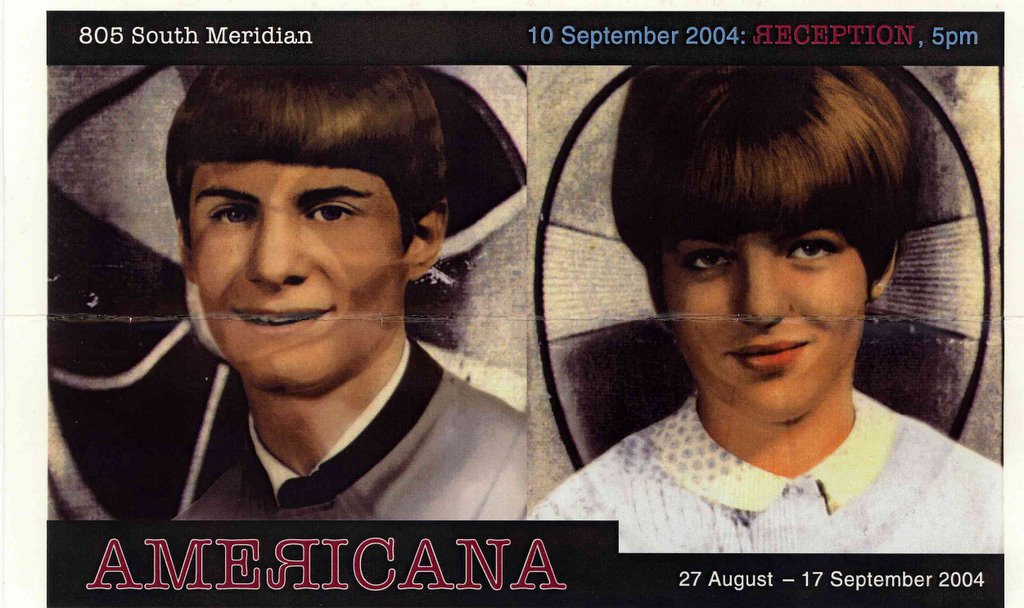
"Americana" - 805 S. Meridian St. - Sept. 15, 2004 - 4 1/2 stars


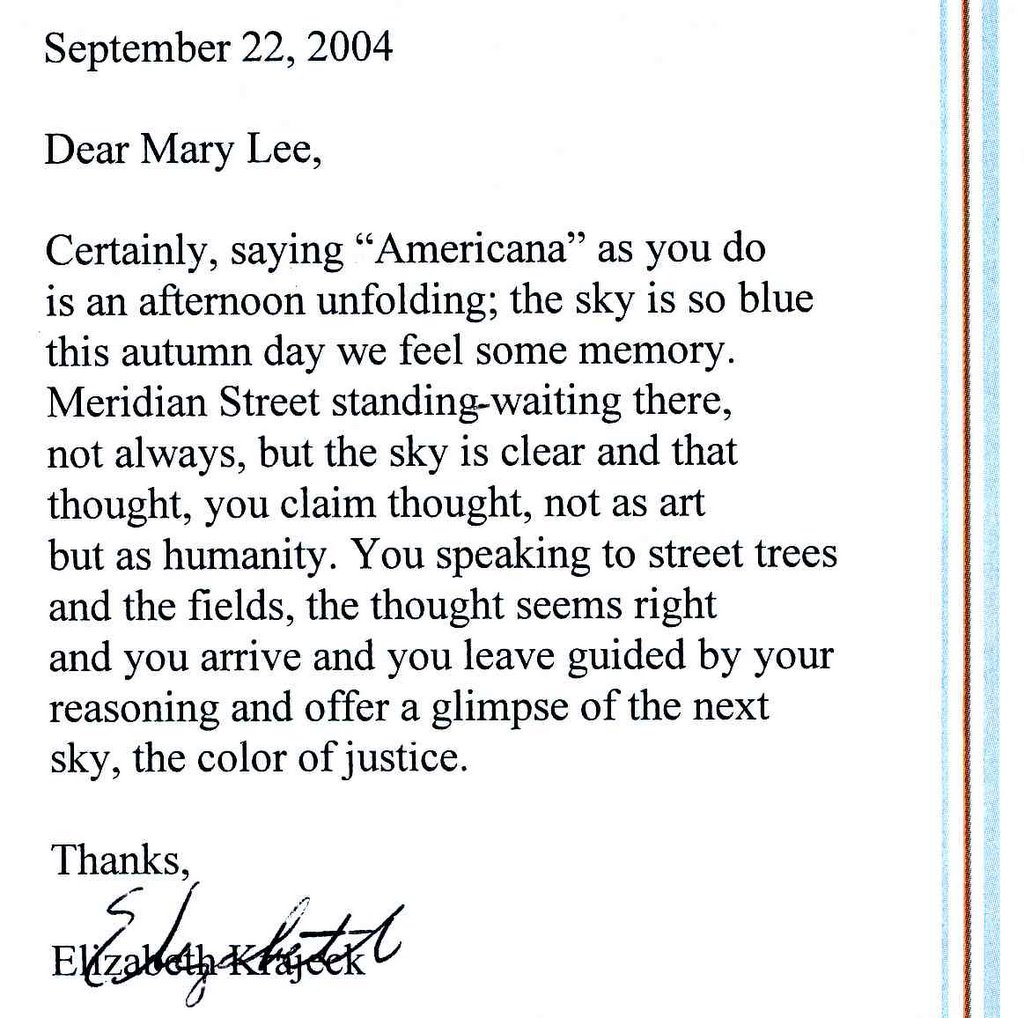
Dear Laura Bush, poets are writing more anti-war poetry now than ever even with your censorship of it at the White House. And the poetry of Elizabeth Krajeck ("Color-coded Sin Advisory System" and "Color-coded Homeland Security Shame Advisory Card") inspired this satirical and passionate exhibit curated superbly by artist/photographer Jack Hartigan. Krajeck's poetry paint chips and expressions of grieving for democracy fill a chalkboard as you enter the space, setting a smartly critical tone of how free speech has been stifled under the current "W" administration. That sweeping theme is allowed to breathe in this space, with each participating artist's political statements being expressed and understood without the use of pretentious, contrived or overblown jargon. Every piece in this show is of great quality and could stand alone as simply a great piece of art. Though each piece is worth discussion (aesthetic, technique and intent) the photographic works of Hartigan are ripe with shrewd satire and censure of the current state of our government. A portrait series based upon a 20th cerrtury German photographer, Walter Sanders, depicts Indianapolis citizens, including one of a Latino immigrant. When viewed in the historical context of Sander's work, the image addresses the issue of temporary work permits that enable a modern state of slavery and questions the current state of human rights. "It's Almost 9:11; Church and State; It's Almost 9:11 " is a piece that takes direct aim at civil rights without brashness. It's a six-image photographic triptych, half true-life documentation of a local Catholic elementary school and half of enlarged studio-shot hands - a hand over heart during the recitation of "The Pledge of Allegiance," a handshake between a white and black hand and hands in prayer. Our flag hangs above a picture of Martin Luther King and President George Washington in one frame with another frame showing a statue of the Virgin Mary draped with a rosary that also shares the classroom space. A cut out of Sponge Bob near the statue reminds us of the effervescent youth that inhabit this school and of childhood. The clock on the wall indicates the time as nearly 9:11 a.m. The center scene is a close-up image of a child's awkward new cursive on large lined beige paper that reads of gay hate rhetoric posted with other written assignments displayed in the school's hallway. It is shocking and sad, but also a reminder of the freedom upon which this country is based and of what faith truly is. Other participating artists are Angela Edwards, Adam Noel and Linda Adele Goodine. For more information contact Jack Hartigan at jchartigan@iupui.edu. Through Sept. 17; 955-8601. -Mary Lee Pappas

Wednesday, August 25, 2004

"Artist Trading Cards: An Interactive Experience" - Indianapolis Artsgarden - Aug. 25, 2004 - 4 stars

Aug. 21, 2004. Artist trading cards were initiated in 1997 by Zurich artist Stirnemann. Basically, they are baseball card-sized (2.5-inch-by-3.5-inch), 2D canvases of paper that artists and non-artists create and then trade. There is no money or sales involved in the social exchange of cards, which is essentially performance art. At this event, initiated by local artist John Essex II, people were encouraged to create card works of art, view his exhibit of cards from artists around the globe, including students at the Girls School where he teaches, and be participants in this performance. This idea is not only cool, but really works to engage people in the arts via tiny canvases and familiar tools (markers, magazine clippings, colored pencils, etc.) that are psychologically freeing. It was and is successful. With many random passers-by indulging in the creation and exchange of these cards it is hoped that we'll see more Artist Trading Card events in the city and on a regular basis. Contact John Essex II at jessex2@emaii.com. Phone: 317-631-3301. -Mary Lee Pappas

Wednesday, August 18, 2004

Patricia Cole - Indianapolis Art Center - Aug. 18, 2004 - 3 stars

View these works only after reading Cole's very personal artist statement. It will give you a reference point for her sincerity and sense of emotional exploration that plays out as you walk down the west hall of the facility where her 29 works of meditative doodling hang. All the pieces are ballpoint on Bristol paper that further lends the feeling of meditative doodling where formality really does take the wayside of purpose in process. Contemplative renderings where tangible subjects phase in and out of mystical checkered realms, the works are a series of varied tones executed in simple crosshatch. Cyclical intertwining doodles appear like abstracted murmurs. They are like seismography of the soul interpreting every tremble or passionate upheaval that comes with the psychological aftermath of war. Through Aug. 29, 2004; 317-255-2464. –Mary Lee Pappas

Wednesday, August 11, 2004

Kay Grimm "The Revival of the IV Apocalyptic Horses: Evolutionary Revelations, install #1 " - LAMP - Aug. 11, 2004 - 3 1/2 stars

Grimm is a very thoughtful artist whose work reflects her desire to emotionally investigate either her identity or her community. Her latest installation is, simply put, about making our community (local/global) a better place to live. Not a mind-bender (to her credit) that is expressed successfully through overlapping Christian/American Indian spiritual symbology - none of which is executed in a bastardization that would be an offense to anyone subscribing to those spiritual sects because her approach is intelligent and knowing. Toy hobbyhorses, representing the four horses of Revelations, are the messengers of gloom and doom and given the colors of the four directions (red, white, black and pale) which represent the earth and the cycle of life. In this case that life cycle is peace to war and death. The toy horses are on posts anchored to bowling balls (life ain't no game?) that literally show how we accept life as a merry-go-round. Grimm begs the question: "Can evil transcend personal ego and view how our choices reflect and impact society on a larger scale?" Ultimately, this piece, composed of many separate installation vignettes including "Confession Booth Drama" and "Herd Mentality" is about living life to the fullest. My only disappointment is that this piece deserves a larger setting and more dramatic lighting than the modest space it is contained within. That said, more galleries should be opening up their spaces (and their brains) to quality installations such as this. Through Sept. 4, 2004. 317-624-9803. – Mary Lee Pappas

Leah S. Traugott, Lois Davis, and Brouwer: "Triple Treat" - Hoosier Salon - Aug. 11, 2004 - 3 1/2 stars

Leah S. Traugott, Lois Davis, and Brouwer show their works together in this show that highlights the best of their talents. Davis' work is presented with more care here in part because of the choice to exhibit her lovely pen and ink figure study sketches. They possess a certain sophistication and ease that isn't totally realized in her paintings. "Nude," in particular, a tea stain color washed pastel and ink drawing of a model has the swift and knowing minimal movement of an Asian painting. It is a piece that demonstrates the breadth of her talent as a fine artist. Brouwer's wet landscape watercolors allow her applied dark colors to muddy into each other, effectively heavy with atmosphere. The result is a reality as if remembered in a foggy dream or memory. "A Sense of Place," aptly titled, depicts a distant barn through a haze of army green and deep teal where pink and yellow tinged light bounces off a silo. Traugott's sweet watercolors of fresh cut garden flowers in random cupboard pitchers offer more than meets the eye. Though the compositional arrangements in many pieces are somewhat uninteresting, there is skill that usurps the safe arrangements. Through Aug. 28, 2004. 317-253-5340. -Mary Lee Pappas

Wednesday, August 04, 2004

"Get the Vote Out" - Stutz Gallery - Aug. 4, 2004 - 3 stars

A campaign by the American Institution of Graphic Arts to encourage voter turnout, "Get Out the Vote" is an exhibition of local and national poster competition entries. Only one image, the local competition winner entry by Terry Howe, really spoke to me as a graphic should. No other entry grabbed my attention or emotions with color or a strong pictorial scene and message as this one did. "For 80 years, an average of just over 50% of US residents have turned out to vote in presidential elections," the top of his poster reads. Red bar graphs (showing the stats over the last eighty years) form stripes that only go half way up a row of American flags. The literal interpretation of the stats in this design are more poignant because this one symbol of our freedoms isn't complete and in essence isn't realized by American citizens. It's a reminder that every vote does count and that everyone should exercise this freedom. All of the entries can be viewed at www.aiga.org/content.cfm/getoutthevote. Voter registration applications are available at the Stutz gallery. Through Aug. 20, 2004. 317-926-2980. – Mary Lee Pappas

"After Midnight" - The Bungalow - Aug. 4, 2004 - 1 1/2 stars

At first, the collected paintings looked like 20-inch by 24-inch Shrinky Dink stained glass because of their stucco appearance. The surfaces are more like textured truckbed lining than genuine impasto. They adhere to staying within the lines with draftsman-like precision and flat colors. Metal silver frames set this generic rigidity off. Compass composed circles and lines zigzag across the compositions, lacking depth and detail. Executed methodically with two layers of oil paint, the results look like decoratively finished house paint. Through Aug. 31, 2004. 317-251-2782, vvww.skoalar.com. - Mary Lee Pappas