Wednesday, April 30, 2003
Plein Air Paintings from New Harmony - Hoosier Salon - April 30, 2003 - 3 stars
This group shows the broad range of style presented by these artists. Highly representational works in true-to-life colors are expected and found on the uncluttered gallery walls, making the diversity ever apparent. "Yellow Tavern" by Dave Kercheval, a lively New Harmony street scene played out in cotton candy pink, tweety bird yellow and glitter, is a primo example. It's great and works to create the illusion of reality in the same way the more traditional colorists do. Illusion is further achieved with incongruence of perspective to the buildings depicted and serves as another element that made this work stand out. Thomas Robinson's "Spring Hillside" is another standout with its purples and vigorous yet careful paint handling. The framing and presentation is always superb at the Hoosier Salon. Through May 7, 2003; 317-253-5340. - Mary Lee Pappas


"Facts and Fictions" - Domont Studio Gallery - April 30, 2003 - 3 1/2 stars
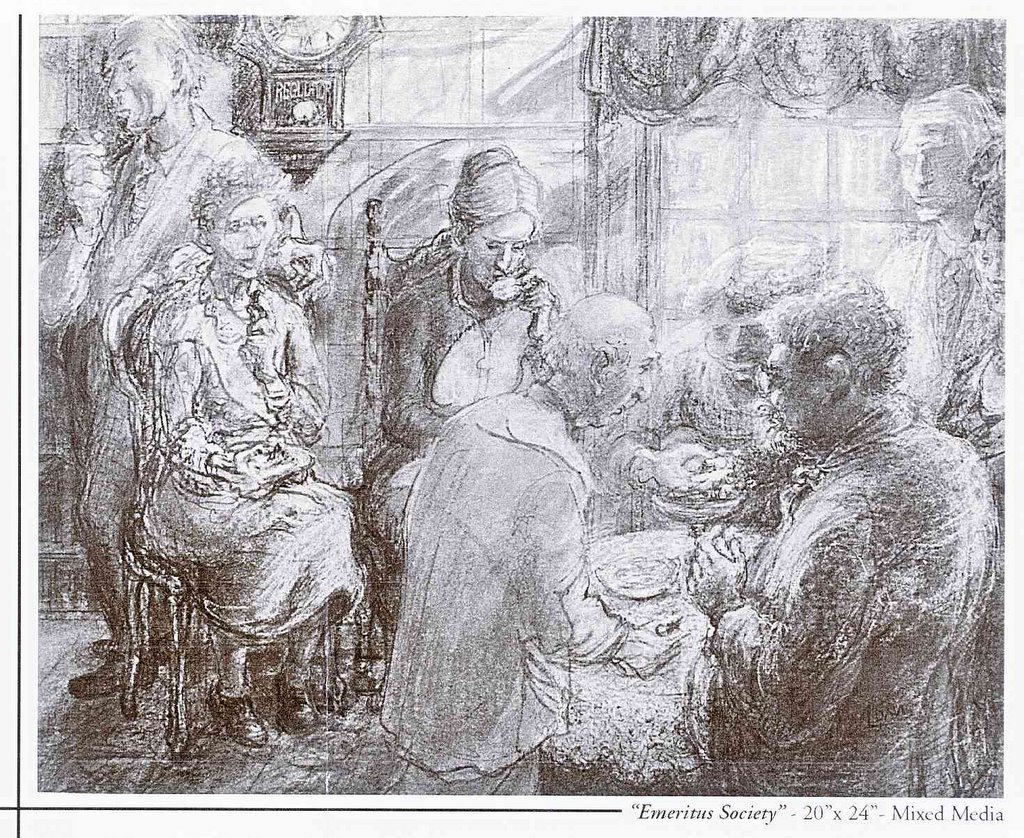
Facts and Fictions: Harry and Lois Davis
Harry and Lois Davis, married for 55 years, exhibit their stylistically different works together with wonderful and not surprising success.


Lois tastefully tackles social issues in her imaginative, figurative works with lilaclike pastel hues. "Traditions: After a Holiday," a diptych of pre-Christmas sale shopping and post-Christmas returns, shows a funny, but all too true scene of folks relatively void of holiday spirit rushing anxiously to buy now just to take it unsentimentally back. "The Children Die: Winter Enters Our Hearts" is powerfully sad as parents bury their children in the foreground, while havoc plays out behind.
Harry's paintings of buildings familiar to any Indianapolis denizen are amazing. There is no painter locally who is technically comparable or as eloquent. Using acrylic on masonite, paint is thinly and deftly dappled in careful (more like accomplished) layers, creating a beautiful illusion of reality. The texture is super smooth, opaque and tactile, so much so that you can't tell the works on canvas from those on masonite. You can see every brick in the painting of "Coulter Flats," located at 2100 Meridian. The orange-red roof catches noonday sun and contrasts perfectly with the teal sky. Through June 7, 2003; (317) 685-9634
NUVO Newsweekly, April 30 - May 7, 2003
Page 27
Mary Lee Pappas


Wednesday, April 23, 2003
John Bragg, Stephen Hartley, J.D. Nolan - The Photography Gallery - April 23, 2003 - 3 stars
Hartley's negative processing technique requires a flow chart to explain. It's something like developed slide film like regular film, made negative of images, then played in Adobe PhotoShop. Dissection aside, the image result is somewhat rough, punky and clearly unique. Nolan sticks to traditional darkroom processing, an old-fangled formula compared to the new high-tech norm. Ordinary images, like "Sunflower," a straight-on shot of the flower, get color enhanced by oil pencils delicately detailing. Bragg, who shoots professionally for Indy Men's Magazine, is a plain-old great photographer. His candids of Ballet Internationale dancers at rest in the wings hang on the gallery's east wall like a journalistic photo essay. They're damn near perfect. Stripped of glossy stock and sharp graphics, the pure artistry of his work can be seen in these inkjet prints floated on white mats. The grainy quality works in his favor to sculpt out the white-on-white image of Emily Griffen, chef at Tavola di Tosa. Through April 25, 2003; 423-9237. - Mary Lee Pappas
Eclectic Art Sale - Artistik* - April 23, 2003 - 2 stars
One of those two stars is a sympathy star, a designation never before handed out, simply because the venue is brand spankin' new. Though pottery classes, photography, art and picture framing at affordable prices are touted, this venue opened with a whimper. Silver in the City inhabited this space previously and you'll know it because their old signage still traces the bottom border of the windows. This is just one obvious sign of unpreparedness. The art on paper wasn't adhering to the mats they were floating on and were unframed (in a frame shop to boot). Though I was unimpressed with the poor display and presentation of the work, I sincerely wish for them not to go the way of Rocky Mills and Gilda's. The venue has the good fortune of settling into a fine piece of Mass. Ave. arts district real estate, but this address alone is not enough to validate it. Through May 4, 2003; 317-638-0791. - Mary Lee Pappas
*Artistik closed its' doors several months later.
*Artistik closed its' doors several months later.
"Turn On" - LAMP - April 23, 2003 - 3 stars
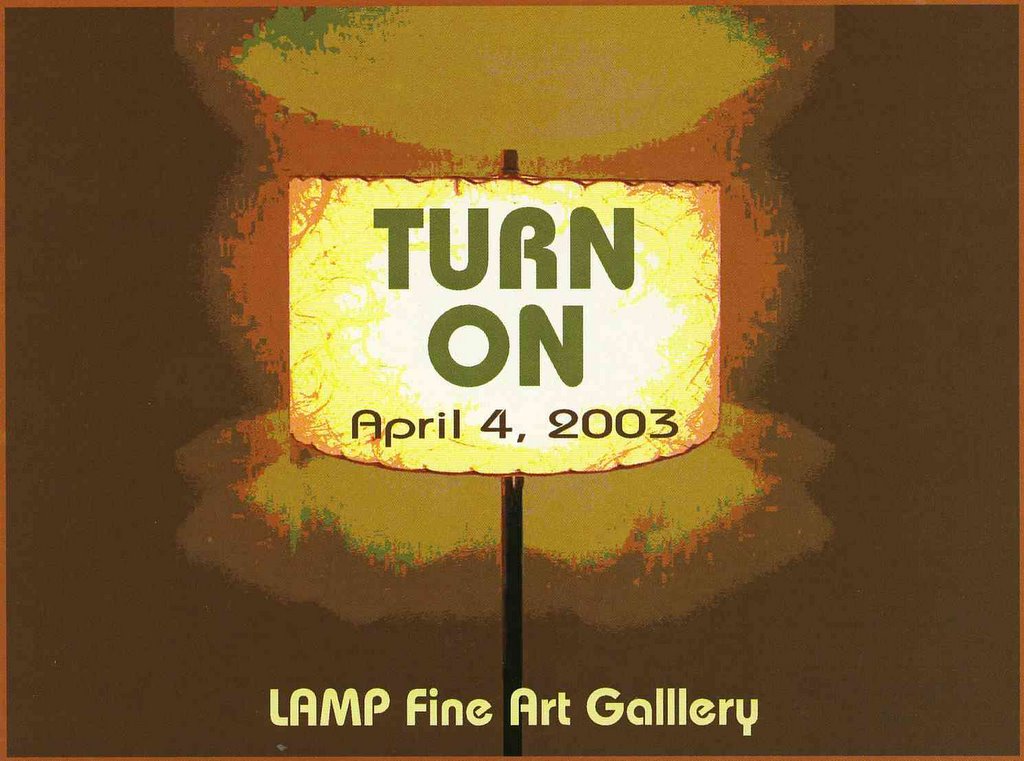
A gallery that started with know-how, talent, sharp survival instincts and not a whole lot else proves that the community wants quality art. This 11-artist group show is another in a series of solid displays of local artists without representation who seek out this professional venue. A lyrical photographic series of a girl and an old window by Herron student Laura Elizabeth Boone was sold-out. The dirty, salvaged window-props cloud the square format images. The girl, sometimes dramatically holding the window, is drenched in beige and nude color though severe light is hitting her. The work is Eyeblink worthy. I can't help but hear a Tom Tom Club song that goes, "With my boyfriend, my lucky boyfriend," every time I see a piece by Greg Seagrave. Multiple layers of bright primary colors zigzag into funky patterns. Mosaics of color with an intricate graffiti feel fuse well and somehow manage to be easy on the eyes. The details make his work more than decorative. The fanciful, not imaginary, landscapes of Ron Stock have a Dr. Seuss whimsy with peter Max colors, only Peter Max can't paint as well. Cheery, Bulbous, lavender trees and orange sidewalks outlined in black are technically refined in execution, making them effectively playful. Through May 31, 2003; 624-9803. - Mary Lee Pappas
Wednesday, April 16, 2003
Shannon Lo "Beauty in Simplicity" - Fountain Square Library - April 16, 2003 - 1 1/2 stars
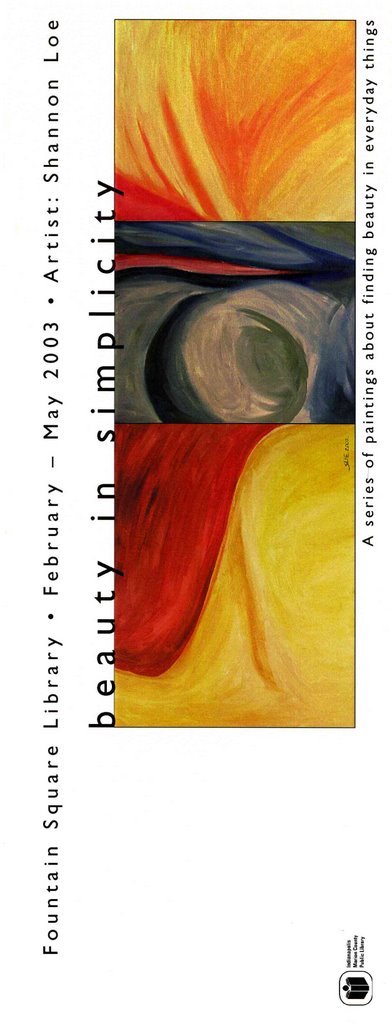
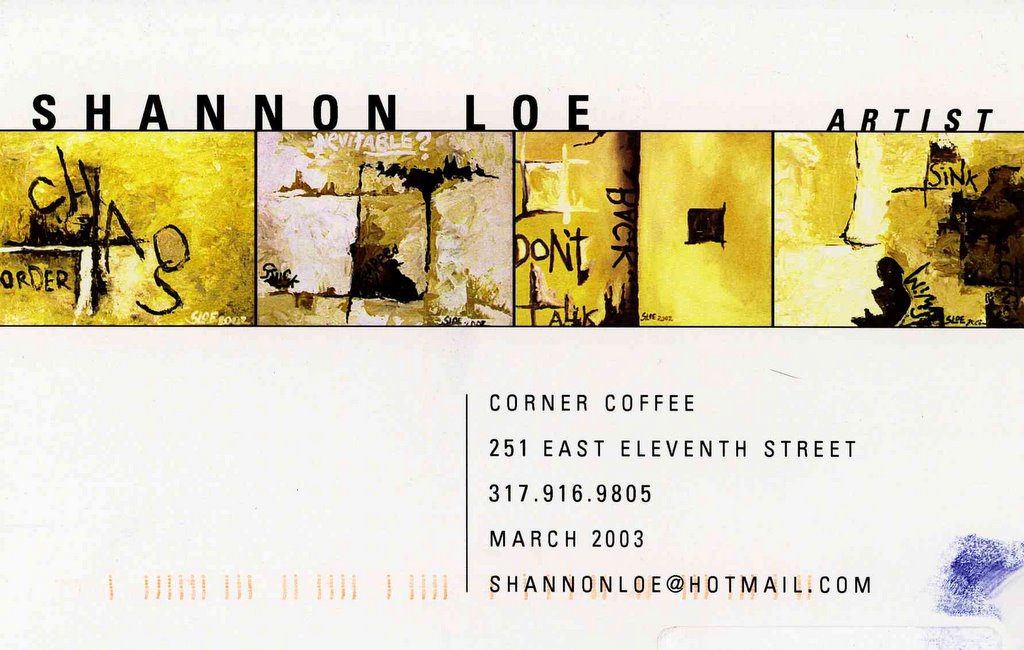
Depth and contrast are missing in these nine simple and dull colored abstract works. Uncomplicated biomorphic swirls and close-up twists are painted timidly. They are an anxious attempt to be something more than whim. This show is a reminder that, ultimately, an artist creates to satisfy oneself and never-ever for review. Putting art out there for the world to see takes guts and has to go hand-in-hand with the desire to elevate that art, to learn from the experience, Objectivity and detachment can be uncomfortable lessons, but improve the purpose for the artwork. A promotional card reads, “A series of paintings about finding beauty in everyday things," which very well could mean finding beauty in the experience of painting. Through April, 2003; 317-269-1877. –Mary Lee Pappas
"Beyond Enron: The Politics of an Aesthetic Revolution in a Post War Economy" - Everyday Inventors - April 16, 2003 - 3 1/2 stars

The only gallery to boast a time machine, Everyday Inventors parodies art as big business better than some do professionally through performance, video, photography and funny fake name badges. It's too bad extra curricular cash can't turn their well-defined let's-pretend concepts into reality, but that's part of the parody, too. "Politics are imbedded in this aesthetic revolution,'” the exhibit statement, "Beyond Enron 2003 Conference" pamphlet, states. "Studies have shown that fine art can no longer survive in museums and traditional gallery space." Beyond Enron emphasizes that a gallery is like a corporation based on aesthetics. Smart and well-conceived, El is tastefully raising the local bar for art with modesty. Through June 6, when their next exhibit, Time Travel Experiments, opens; 317-955-7577. -Mary Lee Pappas
Wednesday, April 09, 2003
Sofiya Inger - Borders River Crossing - APril 9, 2003 - 3 1/2 stars
A single 5-foot-by-10-foot painting, “Vanishing Worlds," hangs alone in the quiet coffee shop. There appear to be six scenes of turmoil acted out in fragmented human silhouettes that Inger refers to in her statement as "bullets," "despair" and "ill." Hot yellows and oranges flare like fire against tile deep burgundy cloth they are painted on. Cool contrasting blues and rich greens create depth and visual comfort recalling a Russian expressionistic/folk tradition. A soft and curvilinear treatment adds to the melancholy meets fantasy mood. The contemporary evolution of humanity has taken some decidedly less than humane stumbles. This is a timely piece of art that approaches truth through genuine sentiment. lnger is represented at Woodburn and Westcott where more of her work can be viewed. Through April, 2003; 317-574-1775. –Mary Lee Pappas
Tim Harmon "The Disposable Coffee Caddy Redefined" - Cath Inc. - April 9, 2003 - 3 stars
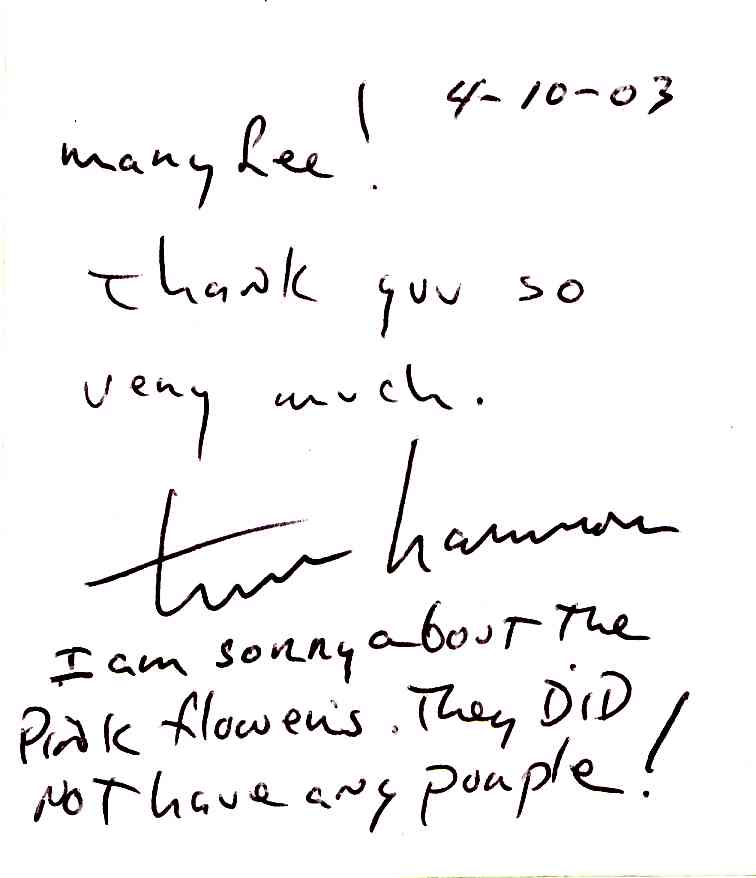
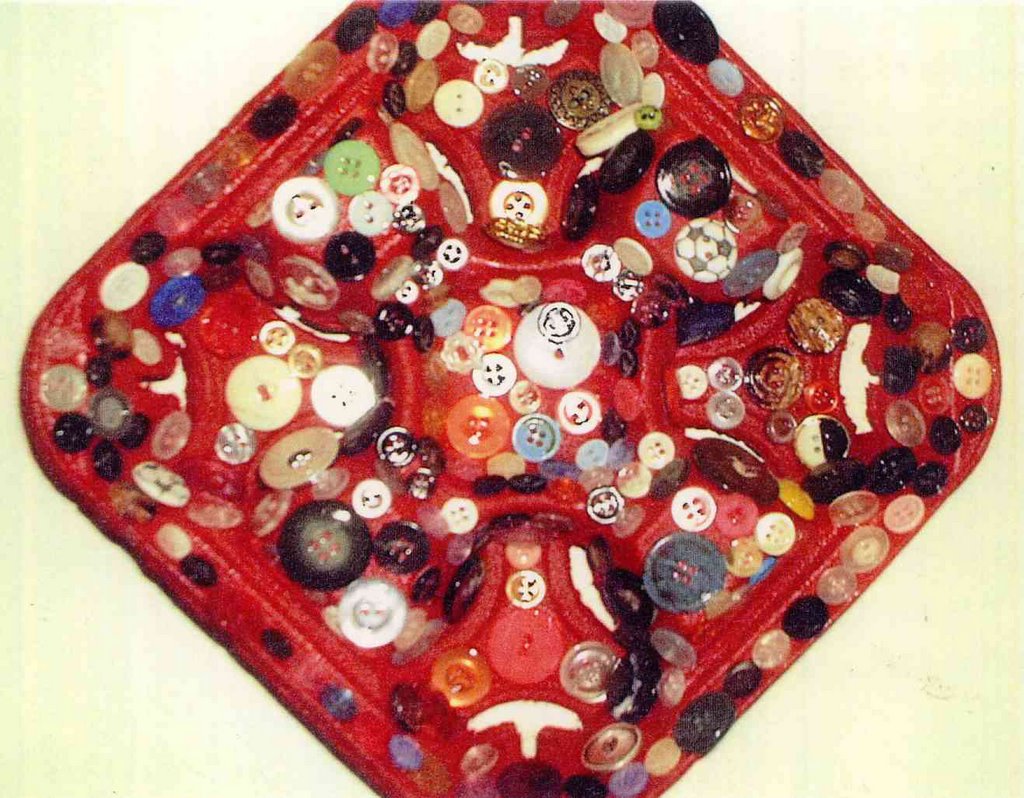
Harmon, of Tim'n'Avi fame, presents 30 good-humored, rethought and recycled four-cup coffee caddys. The pressed composition cardboard trays, strictly utilitarian and immanently disposable, are affectionately appreciated for their purpose and keen design. Silly, impractical and sometimes in left field, this show is not short on giggles or smarts. Caddy #24, "Let It Be" War Scene, features little plastic Army men battling it out on their sand glued caddy under little plastic Iraq and American flags. Crank the music box hidden below and the Beatles' "Let It Be" chimes like a lullaby. It's a sweet message of peace that sucks you in with its playfulness, but doesn't bonk you over the head a la Michael Moore acceptance speech. Caddy #21, nothing more than a cast aluminum caddy made with the assistance of artist Eric Nordgulen, wonderfully emphasizes the design competence of the paper product by timing it into a sculptural piece of an. 'Rainbow Glitter," Caddy #9, with glitter glued all over, is a hoot. Each caddy is more amusing than the last, whether it be "Zen Garden," "Candle," "Jesus on His First Easter" or "Antique Quilt." This stop-and-smell-the-flowers show (take note of everyday design) is a happy offering by someone who loves art and sees artistic potential in all sorts of salvage. Through April, 2003; 317-251-2677. -Mary Lee Pappas
Wednesday, April 02, 2003
Jason A. Miller - Starbucks (3778 Meridian St.) - April 2, 2003 - 3 stars
Two framed landscape photos rest on an easel in the northwest corner of this intergalactic coffee shop. This could be a relatively nice exhibit venue if art could be hung on the west wall and if that particular wall wasn't covered in ugly corporate wallpaper. It would have been great to have seen more work by this photographer. The glossy photo images are slightly blurred, evoking memory and sensory feelings. Colors are cool and few, with black shadows that fuzz out. These very beautifully composed scenes are dreamy and captivating. 317-920-8670. -Mary Lee Pappas
Wednesday, March 26, 2003
William F. Kaeser - Midland Arts and Antiques - March 26, 2003 - 3 stars
Fourteen paintings by Indiana artist Kaeser, from his estate, are currently available for sale by Tom Shipley at Midland. A 1932 Herron graduate, Kaeser is probably best known for his WPA post office mural, "Loggers," in Pendleton, Ind. Having studied with William Forsyth and Clifton Wheeler, the German-born Kaeser painted his share of Indiana landscapes and was as such affiliated with the Hoosier Salon. He exhibited at the New York World's Fair in 1939, much to his credit as well. Modern figurative works were his preference and reflect the crammed, active spaces presented in this group of work. "Topless Tango" has a Good Times feel to it. Its compressed composition of furious topless dancers stacked next to each other has a folky flatness. Most of the pieces, images of Midwestern common man condition, have this mo5aic ambiance. Priced fair for worthy pieces of Indiana art history and worth a look. 317-730-4573. –Mary Lee Pappas
Douglas David "Indiana Peonies" - Midland Arts and Antiques - March 26, 2003 - 3 stars

'INDIANA PEONIES': DOUGLAS DAVID 3 stars Midland Arts & Antiques. Blankets of lush, predominantly pink peony oil paintings line the entrance walls at Midland A palette of soft, rich periwinkles and pinks cover the unframed canvases, creating a light and airy atmosphere. Unrestrained wide strokes push these safe and minimal colors into their bushy flower likenesses. Though paint is handled loosely, the romantically pretty work is too safe to be truly expressionistic, The sense of grace and pastel hues recall Rococo, though are nothing Watteau would know. David beautifully composes his still lifes by gently balancing form and tone. The eyes move gently through his pieces. The small crop-shot peony bloom series is abstracted just enough to suggest their bunchy shapes. This could be said of his even smaller peony oil sketches, full of whirlwind energy, that are a bargain at $65 each, two for Sl 00. His landscapes carry lavenders and deep blues experienced at sunset. By default, everyone in Indiana will have a David work of art in 2003 because he designed the new license plate. Through April 27, 2003; 317-267-9005, -Mary Lee Pappas
Wednesday, March 19, 2003
Randall Scott Harden and John Reynolds "Close to Nature" - Hoosier Salon - March 19, 2003 - 3 1/2 stars

The new and without question improved Hoosier Salon Gallery can boast space, better fighting and easier access to the organization. Traditional Indiana landscapes get a color-tinged twist in the works of Harden and Reynolds. Harden's painterly depictions of Power-laden scenes are executed with thick impasto swabs of color impressionistically dabbling his canvases. His picket fence views are less inspired than the nearly biomorphic oil on paper small landscapes. Smooth and shiny, they are abstracted just enough. "Sunlit Givery," with its purples and pinks against green and hints of blue and hot red on the horizon, are a testament to his well-balanced visual talents. John Reynold's many rooster, cow and nature paintings are executed expressively with a cooler color palette and softer hard. Teals and pea greens shadow and highlight his roosters while contrasting vibrantly against the red-red cock's combs. "Hereford at the Fond" is a comparatively tiny piece at 7-inches-by-5-inches. It's a realistic representation of a cow you'd want to know, with streaks of purple reflecting in the white waters, Both artists are excellent and produce quality in their traditional genre. The Hoosier Salon is a prime, and recommended, spot to view and weigh the transition traditional painting is undergoing in Indiana. Through April 12, 2003; 317-253-5340. –Mary Lee Pappas
Jennifer Bartlett "Prophetic Agenda and the Feminine Mystique" - Jarrett Engineering - March 19, 2003 - 1 1/2 stars
(5335 N. Tacoma Ave.). A federal judge ruled in 2001 that Barbie could be parodied by artists it, their work. Since then, artists have much abused this Mattel medium to explore sexuality, female stereotyping and pop American culture. Barbie exploitation is seen so often that it has become pitifully cliched, particularly in contemporary art photography. Just in time for Lent, Bartlett presents a softly focused, dramatically lit Barbie and Ken enacting stories of the Bible and the Apocrypha in this photo series with titles that include "Eve Defies Adam," "Ester Saves the Jews" and "An Adulteress Repents." You need not be a Bible-thumper to be confused by this show. It's a wee bit overwrought with intended symbolism, among other things, to be just goofy. Local photographer Cy McOuigg, who has done comparable doll imagery, does a much better job. Located in the far corner of a smoky old office (you have to weave between work stations to see it), the work is framed really nicely, complete with brass title plates. Not all atypical art venues work (hair salons, for instance) but the staff was gracious and this office had an eclectic charm. Here is a random smattering of national Barbie art photography to peruse: www.geocities.com/micromarty/ADbarbie.htm; http://helios.acomp.usf.edu/~difrey/. Through March 21, 2003. -Mary Lee Pappas
Wednesday, March 12, 2003
Caroline Mecklin - Deano's Vinos - March 12, 2003 - 4 1/2 stars
Mecklin, known for her nudes and portraits, presents an outstanding new body of work. Her approach to painting is so distinguishable and proficient that it is a delight to see her stretch beyond her already high standard of excellence. Everything is polished. In one piece, a pastel lounging woman is framed by the fabrics she lies on - shapes and dashes of bright color surrounded by black. The spontaneous, patterned image advances toward the viewer and conceptualizes reality and the human form. This odalisque is elegant, beautiful and masterful. Another portrait, in charcoal, is inspired. Mecklin's unending artistic examination is demonstrated well here and worthy of note. An artist reception will take place March 21. Through April 4, 2003. –Mary Lee Pappas
Edie Gray - Joe Reuzar's Deli - March 12, 2003 - 2 stars
While the black beans and rice at Reuzar's were delicious, the art on the walls was bland and state. The collection of naive acrylic abstractions lacked technical substance, yet were still expressive, maybe even personal, in their own psychedelic way. Unfortunately, they carried a generic, replicated look. Only "Soul Dance," with its swirly pastel colors, had a more fluid edge. The manipulated photos on display better expressed the artist's aesthetic sensibilities. While the compositional continuity was maintained, the colors were hotter and the warped forms had depth. The work was enhanced by excellent matting and framing. The photos spoke for themselves. 317-916-DELI. -Mary Lee Pappas
Wednesday, March 05, 2003
Me, Myself and I, Self-Portraits - Indianapolis Museum of Art - March 5, 2003 - 3 stars
The collection of self-portraits, from Durer to Rauschenberg, are sensitively conceived representations of the artists’ personalities and serve as valuable documents of art history. Primarily black and white images (etchings, engravings, lithos and drawings) are crisply presented in plain, bleached wood frames with white mats. Ibis enhances the sketchy and intimate feel of the show. Self-portraits are, as the exhibit explains, "artistic exercise” that every artist utilizes to sharpen skills. Aesthetic sensibilities, status and technique are sharpened through these self-studies. They convey what the artist thinks of herself or, in the case of this grouping, mostly himself. George Cruikshank, who illustrated Grimm's fairy tales and Charles Dickens works, represents himself in the same manner as his famed illustrations. A piece by a promising Indiana artist f the late 19th century, Charles David Fiscus, is displayed. One of only two works completed by this artist before his death at the age of 22, it is delicately and masterfully rendered, especially when compared to fellow Herron student Glen Cooper Henshaw’s pompous pose. This is a show (the Goya and Mora pieces are very cool) that artists and students of art history should see and savor. Let's hope this gallery doesn't experience the abnormally high levels of humidity plaguing the Turner Gallery next to it during this wet weather. A renovated facility with more than a mere hygrothermograph can't come soon enough. Through March 9, 2003; 317-923-1331. -Mary Lee Pappas
Wednesday, February 26, 2003
Full Circle: James Willie Faust - Domont Studio Gallery - Feb. 26, 2003
Full circle: James Willie Faust
Visual Arts Review | Thru March 22
Mary Lee Pappas
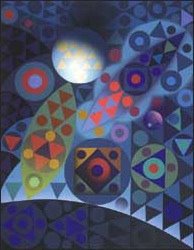
*Pictured: "Auspicious Night" by James Wille Faust
John Domont speaks articulately and poetically for the art he represents at his Domont Studio Gallery. His words are coup for gallery hopper James Wille Faust, who has settled at Domont for his first solo show in three years. Simply said, the paintings are more of the same - more rote than ripe. A myriad of highly defined, primary colored, stay-in-the-lines circles and triangles wading or warping in modular forms. They need only a black light to enhance the psychedelic optical illusions.
Distance is best for viewing. Pencil marks peek from around the shapes, serving as reminders that these are created by human hand. The repetitive, mechanical formula within Faust"s compositions appears playful and familiar. Hanging powerfully as a group, it"s apparent that his superior color balance and tonality have become more sophisticated and refined.
Internally, the pieces visually contract - not unlike the works of Op artist Auguste Herbin whose famous 1944 "Air, Fire" painting fundamentally achieves what Faust"s do, but without a final acrylic airbrush layer. This body of work (landscapes and the human being series) is, coincidentally, titled Earth Air Fire Water, in tribute to those elements. One influence on these pure-effect works that command questionably steep prices could be early sales successes.
Faust, actively collected locally, is a favorite big fish in our little pond. But his brilliant sculptural models, intended for monumental public works of art, make his paintings look like sketches. Given the opportunity, Faust"s artistic vision would gloriously come full circle. Geometry within geometry, these 3-D pieces bring his hard-edge imagery to spectacular, inspired life. It would be in the interests of the Indianapolis Art Center and the Indianapolis Museum of Art to include him in their sculpture park plans. Through March 22; 685-9634.
Wednesday, February 12, 2003
Bartosz Pietrzak "Pietrzak Puls" - The Photography Gallery - Feb. 12, 2003 - 4 stars

Photographer Bartosz Pietrzak was exiled from Poland in 1982. As a member of the Democratic Opposition Movement, which started in 1976 and became the future inspiration for the national solidarity movement in Poland, Pietrzak was co-editor and photographer for an underground paper, the Puls (Pulse). "You had to do something. It was hopeless," he said of his journalistic efforts. Martial law was imposed on Dec. 13,1981, sending him to prison, but not for long. "They were visibly interested in getting rid of us," he explained of the government. Pietrzak was given a choice in 1982: stay in jail or emigrate to the United States. Grabbing a few personal belongings, including photos, Pietrzak and his wife left Poland. Half of the 20 photos on exhibit at the Photography Gallery are piecemeal examples of his black and white work from the 1970s. Some of these were rescued by friends and sent to him here. These images have been digitally reshot, cleaned up and reprinted, resurrecting them with the same integrity as their original gelatin silver prints. Others have been executed over the last three years. "For 20 years I didn't do anything until three years ago," Pietrzak said. Digital photography was the enabling factor. Most all of the works adhere to a photomontage convention. Viewing the photo fabrications of environments and objects is like reflecting on, or entering, a daydream. Unmodified portrait images from the 1970s are strikingly candid. Pietrzak's explorative montage method is successfully demonstrated in this deserving and splendid show. Though diverse, the images have a poetic uniformity. Pietrzak has exhibited in Germany, Denmark, Malaysia, India, Great Britain, Brazil and now, fortunately, in his Indiana home. Through Feb. 28, 2003; 317-423-9237. –Mary Lee Pappas
2003 National Scholastic Art Awards of Central Indiana, Inc. - Harrison Center ofr the Arts - Feb. 12, 2003 - 3 stars

Three hundred terrific artworks selected from over 3,000 submitted by junior, middle and high schools from around Indiana. Eleven professional artists judged and ranked the works as Gold Key (highest award on a regional level), Silver Key (second highest), Honorable Mention and the Best of Show Awards, known as the American Vision Awards. Gold Key and AVA winners' works will go to NYC to be judged for over $1,000,000, in awards and scholarships, then travel to Washington, D.C., for exhibition. Any of the mature Gold Key drawings created in Jonathan Kane's Carmel HS class will give their national competitors a run for their money. His students have quite a competent and comfortable grasp of color and values, Carmel HS and Jefferson HS (Lafayette) are by far the best represented out of the 582 eligible schools. Visual arts magnet Broad Wipp4e HS was represented by a slim picking of six pieces, but happily garnered an AVA and two Gold Keys. Though some of the work isn't completely indicative of students' own freedom of expression, the overall magnitude of talent is great and, even more, inspiring. To say I had a favorite piece in the show just wouldn't be right. But I must admit that as I have painted in my studio, just up the stairs from the HCA Gallery, I've traipsed down to the gallery to specifically visit work by Joseph Chang, Gold Key Fine Arts Portfolio winner from Harrison HS. Through Feb, 23, 2004; 317-514-6787. -Mary Lee Pappas
Subscribe to:
Posts (Atom)