Wednesday, April 28, 2004
"Greatest Generation of Sports Artists in War and Peace" - National Museum of Art and Sport - April 28, 2004 - 3 stars
Sometimes the themes of shows at this museum, located at the University Place Hotel and Conference Center on the campus of IUPUI, feel like a stretch. The "museum" is essentially in the corridors of the convention-heavy facility. This art should create a point of destination for visitors instead of being an afterthought for those who attend one thing or another. This show focuses on artists who, during World War II, served as combat artists, correspondents or were members of the armed forces who happened to be artists. Some of the art is on loan from the U.S. Army, Navy-Marines and Coast Guard. Donald Moss, a combat artist in the Marines and longtime illustrator for Sports Illustrated, served as chairman for the exhibit, which is testament to the quality of work on display. Germain G. Glidden, Ray Ellis, John Groth, Fletcher Martin, Ogden M. Pleissner, Cecile Johnson, Peter Cook and Kipp Soldwedel (a pilot during World War II, he was commissioned to paint a mural for the memorial at Pearl Harbor - "The Day of Infamy") are the wartime artists represented. A very thoughtful and responsible exhibition. Through May 31, 2004; 317-274-3627. -Mary Lee Pappas


"Art Deco" A Decade of American Design" - PH Sullivan Museum - April 28, 2004 - 1 1/2 stars

A humdrum tour of American mass-marketed utilitarian objects in the 1930s. Certainly the parameters of Art Deco are broad, with something for every Modernist's taste and pocketbook - then and now. But this show hovers toward the unremarkable Fiesta ware end. On the high-end of Le Style, an enameled and wood inlaid Kodak camera by Indiana born industrial designer Waker Dorwin Teague is quite nice and significant in contrast with the content of the rest of this small show. Overall, this peek at a decade of design mass marketed to mainstream America reflects a very limited aesthetic of chromed-out, inexpensive daily accessories, like the spun aluminum relish rosette by Russel Wright. It is not a well-rounded representation of Art Deco by any stretch, but serves as reminder of how the ordinary can be taken as art. Through June 26, 2004; 317-873-4900. -Mary Lee Pappas
Wednesday, April 21, 2004
New Works By Indiana Artists - Editions Limited - April 21, 2004 - 3 1/2 stars
Thirty-two local artists working in 32 different genres comprise the first show at the new Broad Ripple location of this 35-year-old local gallery institution. A fresh red front door, natural light, the location and an intimate gallery space are definite improvements. Notable local favorite Lois Templeton gets ample wall space with one large washed abstraction that employs a decidedly brighter than usual palette executed on paper. The gestural quality of her work is emphasized on this surface and appears brasher as well. This is a welcome, energized evolution. On the other end of the scale, a tactile and chalky landscape on panel by Amanda Presnell, an EL art consultant, is calming and deceptively controlled with dark, cool colors. Everything is lovely, of note and worth a visit. Through May 7, 2004; 317-466-9940. -Mary Lee Pappas
"Brickhead #3" - Massachusetts Avenue - April 21, 2004 - 2 stars

Outside of Elements restaurant in the Davlan building at the corner of Alabama and Massachusetts sits "Brickhead #3," a large ceramic sculpture by Indiana native James Tyler. It's a colossal head, sculpted and sliced apart into many hundred brick pieces only to be reassembled. The symmetrical facial features, swollen lips and sanguine expression remotely recall a Fourth Dynasty Egyptian look and some may say that's a stretch. Is there supposed to be an ancient context here of keeping the head away from the body after death? This big terra cotta-colored head, neckless and bodiless, does compliment the brick facade of the Davlan building and the grassy courtyard where it resides. Of better quality and more interesting than most of the publicly displayed sculptural works along the avenue, it still lags. Funded by the Indianapolis Cultural Development Commission, "Brickhead #3" feels a bit more like a gimmick than a sculpture. Sounds are supposed to emit from the head as people wander by, only, unfortunately, it was difficult to decipher if this feature was working. "Brickhead #3" is missing some of the fluidity and detail found in other works by Tyler, making this piece appear to be a second-best effort. Through Sept. 30, 2004; 317-634-3114. -Mary Lee Pappas
Wednesday, April 14, 2004
George Murff "Figurative Expressions - College Avenue Library - April 14, 2004 - 2 stars
Upon walking into the library with Murff's work encompassing the upper periphery of the walls, your eyes are diverted to the primary bright yellow barren background of "Survivor," a portrait recently exhibited at Dean Johnson in No Boundaries - A Multicultural Viewpoint. It may be the best of the bunch. A collection of oil paintings, pastels and watercolors, this body of work has a graphic sensibility to it, not a surprise considering Murff has designed banners and posters for local government, including "Shower your baby with love." Compositions look too extracted from photographs, as does the wavering realistic approach to the work. There is something a little amiss - some trepidation in the depiction of faces - that gives the portraits and figurative scenes in the painted works a stiffness instead of a lively lightness. The style in some pieces isn't personally distinguishable. Though passionate in subject matter, emotion isn't fully realized in the overall finished products. Through April 30, 2004; 317-269-1863. -Mary Lee Pappas
Itza Pizza Art - Itza Pizza - April 14, 2004 - 2 stars
Itza' Pizza usually serves up fresh, hand-tossed crust pizzas with dough made daily. An 8-inch pizza is a mere $6 and a 16-inch is still only $12. Better yet, sandwiches and pastas are all under $5. Open Monday through Saturday, 4-11 p.m., it's also currently serving up art with a portion of the sales going toward the little eatery situated smack dab in the middle of the Fountain Square arts district - one with more art than retail shops. Collectively, the grouping is of pizza-themed artworks - from ceramic vessels and photography, to styrofoam slices. Prices are very low, from around $25 on up. Though tiny, this is a funny, quirky display that does require a basic sense of humor. Through May, 3, 2004; www.discoverfountainsquare.com, 317-635-6252. -Mary Lee Pappas
Wednesday, April 07, 2004
Ugly Dolls, a toy review - April 7, 2004
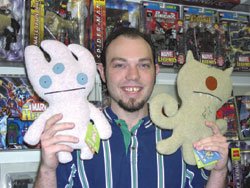
Ugly Dolls
Toy Review
Mary Lee Pappas
*Pictured:
Matt Booher, assistant manager of Comic Carnival’s Westside location.
Forget Kestner, Kewpie and Madame Alexander, the Ugly Dolls are the cuddly wuddly antidoll dolly of today. And they are soooo cute even though they are soooo ugly. “That’s the mentality,” Matt Booher, assistant manager of Comic Carnival’s Westside location, said about their uncommon irresistibility.
Ugly Dolls are adorable dorky alien creatures made of baby soft polyester fleece. They aren’t jointed or multidimensional, but rather flat and pillowy, with appliqued perfect circle felt eyes with itty-bitty pupils. Their simplistic facial features and linear body design give these plush stuffed Martians a charming vulnerability that make them practically spontaneously huggable. Couple that with a few involuntary simpering, “Ahhhhs,” and other loving coos and you’ve got a typical tender reaction to the cartoonish Ugly Dolls.
Though well-suited for a little baby, adults are the primary consumers of Ugly Dolls. “I don’t know why they haven’t caught on with kids. They’re a lot cuter than Beanie Babies,” Booher said. Comic Carnival has been selling out of the dolls at their four Indianapolis locations since they started carrying them six months ago. “They’ve been pretty good for us,” Booher added, saying that both men and women have been charmed to bits by these freaky cuties. “It’s been a mixture. Guys have probably been buying them as gifts.”
People across the country have been buying them, from the artsy-fartsy likes of the Whitney Museum of American Art and the MOCAs in Cleveland and L.A. The success of their design is unquestionable. To learn more about Ugly Dolls visit www.uglydolls.com. Ugly Dolls are available at Comic Carnival’s four locations: North, 253-8882; South, 889-8899; East, 898-5010; and West, 293-4386. Dolls are $19.99.
Gym Stoffer- Joe Reuzers Deli - April 7, 2004 - 2 1/2 stars
A graduate of Herron School of Art, Gym Stoffer has worked in the medium of collage for the past 20 years. An accurate statement read, "He reconfigures commercial imagery into surrealistic dreamscapes filled with hybridized archetypes performing bizarre comedies." His precision cut and paste magazine paper-pieced works take disparate images and transform them into bizarre and dimly colored, somewhat creative compositions. Most are rather amusing with titles like "Robo Eskimo Expo." Looking meticulously conceived, they are quite curious, but don't require stellar leaps of the imagination as most are dependent on visually comfortable and identifiable elements. Nevertheless, the work has definite merit. 317-916-DELI. -Mary Lee Pappas
"Everything Goes Better with Alcohol" - Everyday Inventors - April 7, 2004 - 1 1/2 stars
"An art show about painting and getting drunk," a show description read. This show just can't be taken seriously when the premise was to get drunk and paint the contents the evening before the opening. It was hardly an exploration of process, self-discovery or losing inhibitions to loosen up the creative mojo. The theme is a turn-off, the art is mediocre and you can't tell what artist painted what piece. "The show has legitimacy beyond the brash and garish paintings that may have been influenced by alcohol." This appears to be a statement about an ill-conceived show that may have been written under the influence of alcohol as well. A very disappointing venture from Everyday Inventors, a usually quirkier, inventive and more capable bunch. Through April 17, 2004; 317-955-7577. --Mary Lee Pappas
Wednesday, March 24, 2004
Andrew Hutchison, Skateboard Photogrpher - Two Sisters Trading Company - March 31, 2004 - 3 stars

Hutchison is a skateboard journalist, having both witten and photographed the sport professionally for publications like Heckter Skate and Big Brother. That said, the photos collectively are an essay on the sport. They capture athleticism, speed, motion and even some bloody palms rather beautifully. There is a certain stillness to the images that conjures up the heightened sense of self-awareness and meditation it must take to muster up some of the risky stunts skaters pull off. Lining a hall and filling a little room of this new, funky gift and clothing shop, they are artful and should hold the interest of anyone who appreciates quality photography or skateboarding. A distinct sense of skateboard culture across the U.S. is what you'll take away from this exhibt. Through April 6, 2004. -Mary Lee Pappas
Thomas Kerrigan "Desert Soul" - The Bungalow - March 24, 2004 - 3 1/2 stars

The color of these hand-built earthenware pieces from the artist's Desert Flora Series were oxidized metal. Predominantl opaque surfaces contrasted with high, primary colored glossy glazes emphasizing intricate design elements that appeared hot next to the overall cool finishes. The richly detailed surface treatments of the abstracted ceramic sculptures possess an almost irresistible tactile quality, like sand on a beach that you want to run your fingers through. The complexity of the surfaces and the soft curves of the pieces are imbued with meditation and tranquillity. Though March 31, 2004; 317-253-5028. -Mary Lee Pappas
Brad Schwieger "Cut Constructions" Architectural Vessels" - Artifacts - March 24, 2004 - 3 1/2 stars
The NCECA Convention's presence in the city has, without question, beautified the place. With these high-quality ceramics exhibitions happening all at once at so many venues around town, it was difficult not to get a healthy dose of good art last weekend, no matter which way you turned. Schwieger's (Ohio University Ceramic chair) skewed architectural ceramic sculptures, displayed in the window of Artifacts, were absolutely intriguing. Disassembled and reconstructed built forms possessed flatness and contrasting volume, giving them a kinetic, wobbly feeling. Symmetry in his column pieces (like architectural balustrades) was moderately distorted, creating a visual sensation of melting. This vapor, soda fired treatment only enhanced the animation, the movement of the forms. Through April 10, 2004; 317-255-1178. -Mary Lee Pappas
Wednesday, March 17, 2004
"Common Clay: Creating Old and New Ceramics" - Indiana Historical Society - March 17, 2004 - 3 stars
This is an overview of Indiana's pottery history, including a manufactured piece from the American Art Clay Company (AMACO), which mainly sells pottery supplies now. Most intriguing were examples by the Overbeck sisters, who produced work from their Cambridge City home (now a museum) from 1911 until 1955, when the last living sister, Mary Francis, died. Lovely, abstracted flower patterned vessels (probably thrown by Elizabeth and decorated by Hannah) are exhibited alongside little people and animal figurines, known as "grotesques" or "humor of the kilns" that the sisters made to earn pocket money. An exhibition on the unmatched Arts and Crafts sisters (who took their art secrets to their graves) alone would be most welcomed as this little element of the exhibition was great. Exceptional contemporary pottery pieces flank the second floor, like "Mother's Milk" by Kathy Roussel. It's a white shiny porcelain wall sculpture of three stacked utter covered round forms. A wonderful show overall, it's unfortunate that the pieces were distributed so thinly throughout the facility instead of dedicating a concentrated gallery space to this exhibition effort. Through June 6, 2004; 317-232-1882. -Mary Lee Pappas
Patrick Craig Manning " Cardinal Points - The Photography Gallery - March 17, 2004 - 1 1/2 stars

At the Photography Gallery, when pieces are visually uninteresting, the quality and presentation are usually still quite high, redeeming the work. In this case, the presentation is faulty. The Bitmap Series, multicolored cubes of color that, as the statement explains, are "created by a computer program that randomly assigns 16.7 million possible colors to each file in the digital bitmap file," are printed on an Epson matte paper that bows from the flat black mat boards they are mounted to. This presentation is sloppy for such visually clean work, although one image from the series has a small ink globby in one mini color block that is glaring against the mod design. The artist's intent, that each map is a "presentation of choices, a record of what we value, what we represent, and what we ignore," is ineffective. Through March 31, 2004; 317-423-9237. -Mary Lee Pappas
Wednesday, March 10, 2004
"Cartoon and Caricature from Iran" - IUPUI Cultural Arts Gallery - March 10, 2004 - 2 stars
Artists' statements and inspiration or purpose for the exhibition were not available. Stylistically, nothing about this work suggested a distinctive sense of place. It looked like it could have come out of any American newspaper. Organized by the Iranian America Student Association of IUPUI, this small exhibition of work by Touka Neyestani, Nik Ahang Kowsar and Massad Shojaitabatabai (IUPUI students or artists from Iran?) left something to the imagination. Cartoons and caricatures on display were inkjet reproductions of originals with some colors and details being lost in this process. A predominant theme was that of power struggle touching on the war in Iraq. One cell depicted Saddam Hussein in a Santa suit being approached by a small reindeer that asks, "Are you a Bad Santa?" Many of these frames could very well accompany news pieces covering current events in the Middle East. Through March 31, 2004; 317-274-3931. -Mary Lee Pappas
Maryann Michna "National Road" - Bona Thompson Center - March 10, 2004 - 2 1/2 stars
A video specialist at the Indiana State Library, Michna is too dependent on her camera to achieve painted works that make up this show based on her back and forth travels along U.S. 40, the old National Road, from her home in Terre Haute. There is a meditation that takes place when you drive great distances in a car by yourself with an awareness of horizon points, sky and landscape whizzing by. Epitomizing that experience most effectively is an acrylic on clayboard painting, "Three Views of 40," where three landscape scenes are stacked to achieve this experience. Other paintings executed with acrylics on clayboard are painted in a hurried, gestural way, like a painted sketch. Paint appears flat and opaque as it is thinly applied. The anxious appearance of the work overlooks tone and contrast while simply filling in shapes with some color. Through April 18, 2004;
317-353-BONA. -Mary Lee Pappas
317-353-BONA. -Mary Lee Pappas
Maria Magdalena: "La Familia" - Munce Fine Art Center - March 10, 2004 - 4 1/2 stars
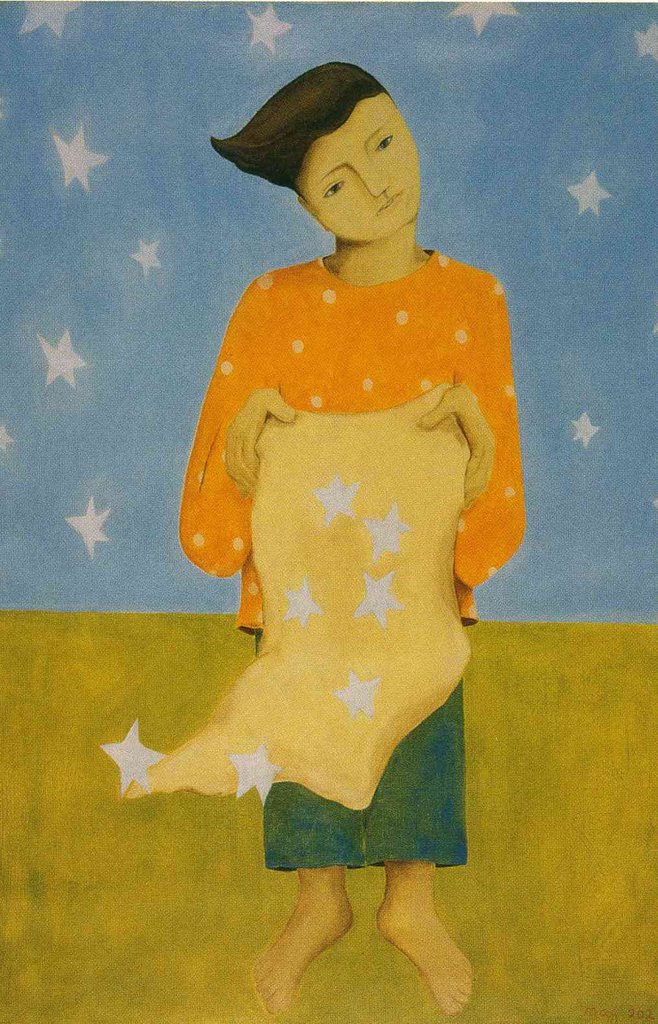
Abbreviated and generalized family portraits in oil, whose circular and rhythmic compositions fill the canvas space, are elegantly linear and refined. The naturalistic faces are masks of serenity, waning on elongated necks. Romantic and weightless, they recall the gentle quality of Botticelli's works (think "Birth of Venus") and Modigliani's portraits though stylistically they are Magdalena's own. Soft, vibrant shades of lavender, cool light blues, yellow and oranges fill the flat pictorial Cubist-like components. These works capture the soul of Magdalena's family. Every element of good painting is represented in this body of work. It should be noted that prices are not only reasonable, but also actually low for this high quality of work. Cheech Marin should have one of her pieces in his collection. This will knock your socks off as will the exceptional blown glass vases by Joan Schneider created specifically to accompany Magdalena's work. Through March 20, 2004; 317-873-6862. -Mary Lee Pappas
Wednesday, March 03, 2004
Judy Leiviska - Cafe Patachou (Carmel) - March 3, 2004 - 3 stars
Leiviska's work on display, monotypes and color reduction hand printed woodcuts, possess a tranquillity through muted color and a linear execution of composition. The elongated quality of the woodcuts is reminiscent of water rushing wherever it goes, giving the work an element of rhythm and life. Colors, such as muted deep purples and greens with an undercurrent of faded orange, further this sense of ease, stillness and softness. One abstracted monotype, on the other hand, is composed primarily of red, yellow and blue (the sacred trinity of color), with touches of washed orange and light blue. The blotches of color, dry and smooth, are given a pulsating life through her gestural application. The basic colors and hot white paper background achieve an engaging, sophisticated abstraction. More of Leiviska's work can be viewed at the Hoosier Salon. Through March 31, 2004; 317-569-0965. -Mary Lee Pappas
Rick Epley - Cafe Patachou (River Crossing) - March 3, 2004 - 1 star
A gallery owner recently asked me, "Who do you think is buying all of these art supplies at art supply stores and craft stores?" Painting prowess doesn't always lie in a particular brand of paint, a certain grade of prefab canvases or any other marketed utensil pointed in the direction of aspiring artists. Aside from acquiring a painting mojo (a very beautiful thing), there is an element of fine tuning that needs to occur, a level of craftsmanship that needs to go hand-in-hand with desire and is to be aspired to. Epley's sequences of strictly decorative, layered squares lacked substance, depth and a sense of color even though the paintings displayed possess bright palettes. These works, filling the north wall of the restaurant, did just that - they filled a bare wall. Through March 31, 2004; 317-815-0765. -Mary Lee Pappas
Christopher Smock - Cafe Patachou (49th & Penn.) - March 3, 2004 - 3 1/2 stars
Acrylic and graphite on board paintings line the very poorly lit south wall - unfortunate for this good show. Nevertheless, red "sold" dots are affixed to the title labels, testament to the astute quality and reasonable prices of these pieces. Produced primarily from leftover theatrical set supplies, these works are polished and superior without a footprint of their workroom origination. Great artist's statement, too. Smock's art doesn't pretend to be anything it's not though it hardly lacks substance. Void of pretension or ulterior motives, a sincere interest in craft shines as this artist has seemingly freed his mind of sales, material cost and ego. Local street scenes, interiors and bustling spaces are laid out in washed layers of acrylic to compose accomplished representational images. Expressionistically sketchy, these paintings are inspired and aptly executed. More please. Through March 31, 2004; 317-925-2823. –Mary Lee Pappas
Subscribe to:
Posts (Atom)