Wednesday, December 05, 2001
Night Vision - Utrillo's Art – Dec. 5, 2001 – 3 1/2 stars


Holiday One Piece Show – Dean Johnson – Dec. 5, 2001 – 2 stars
Wednesday, November 21, 2001
Jo Legner - Hot House Gallery - Nov. 21, 2001 - 3 stars

Subtle kink meets collage in Legner's loosely lurid, bold, black-outlined Japanimation girl paper mosaics. Beautiful and delicately printed Japanese, Thai and English papers are chopped up (most in 2-inch blocks) and reassembled to give life to her large-scale, convincingly innocent (and one or two not so innocent) and, dare I say, cute, sexy cartoon girls. The fairy straddling a flower, the blue girl spread-eagled on the phone, the bunny-girl investigating carrots, the bare-breasted kitty-woman and the other girls on revue are all perfectly composed for their square format, as if they were individual animation cells. Hardly a parody, these pieces are wildly lively, with a fresh sense of freedom and fun in art, yet are created with care and accomplishment. Legner has a keen artistic vision to be able to piece together seemingly unlike paper colors and textures and then have the end results create the right balance of depth and space for her caricatured beauties. Through Dec. 31, 2001; 686-0895. - Mary Lee Pappas
Tuesday, November 20, 2001
Why Collect Art? by Mary Lee Pappas - Nov. 20, 2001

Why collect art?
Wednesday, November 14, 2001
Lynn Thomsen - Woodburn and Westcott - Nov. 14, 2001 - 3 1/2 stars

Thompsen's art is about where we are and where we live. Her pastoral, predominantly green paintings aren't just of the typically expected rural Boone County fields and southern country meadows, but of Eagle Creek and the ultra urban woods of Butler University. The sense of depth and definition in theses scenes is outstanding considering the swiftness at which the strokes look smattered, albeit intentionally, on the paper. Her true color farming fields carry an all too familiar feel that anyone who has driven anywhere in Indiana can appreciate. Thomsen is a skilled artist who fearlessly puts paint down, confidant about space and reality. Through Dec. 31, 2001. 916-6062. - Mary Lee Pappas
**********
Lynn Thomsen, July 30, 1957 - January 3, 2008

Thomsen, Lynn,
January 5, 2008
Indianapolis Star
Lynn Thomsen She passed away at 10:45 a.m., January 3, 2008 at the IU Medical Center, Indianapolis. She was born in Lafayette, IN on July 30, 1957, and lived with her parents in Delphi, until her graduation from Delphi Community High School in 1975. She graduated Summa Cum Laude with a B.F.A. from Herron School of Art in Indianapolis. She went on to teach at Marion College, IUPUI, St. Richard's School, and for the past 7 years she chaired and taught in the Art department at Park Tudor School. Lynn was a landscape artist, and concentrated on scenes of rural Indiana. She has works hanging at the IU Medical Center, The Anderson Hospital, Women's Wing, and in the permanent collection of Indiana artists at the Indiana State Museum, along with many private collections. Lynn was the court room artist at the 1992 Mike Tyson Rape Trial where her drawings were aired on Channel 6 News and ESPN. She currently has a 22 piece show at the Mary Anderson Center for the Arts, Loftus House Gallery, 101 St. Francis Dr., Mount St. Francis, IN. The exhibit will run through March 1, 2008. She is survived by her husband, Clifford Hull, her stepson Clifford Jr., her parents Cliff & Jean Thomsen of Delphi, IN, one brother, Eric (wife Carole) of Delphi, one sister, Teresa Holeman (husband John), of Charleston, S.C.; 4 nieces; Amber Cleavenger (husband Kyle) of Colburn, IN, Cassandra Rowley (husband J.T.) and Erienne Thomsen of Terre Haute, IN., Justine Holeman, of Charleston, S.C., as well as 3 great nephews and innumerable wonderful friends and colleagues. A celebration of her life will be held on Monday January 7, 2008 at 4:00 pm at Flanner & Buchanan Funeral Center-Broad Ripple with a gathering starting at 12:00 pm to service time. Persons wishing to express their condolences may do so by recycling. In lieu of flowers, donations can be made to the Coburn Place Safe Haven 604 E. 38th Street Indianapolis, IN 46205.
**********
In Memoriam: Lynn Thomsen
by Barb Shoup Jan 16, 2008
NUVO

When Lynn Thomsen and I traveled through France together in 1994, she carried a packet of blank cards wherever we went and made sketches on them, which she sprayed with fixative and sent home as postcards to family and friends. I was fascinated by what caught her eye. The pattern of stones beneath the running water of a river, the peeled paint of a shutter were as interesting to her, as worthy of her attention as the Eiffel Tower or the Louvre. She made a sketch of me to send to my husband — not at Monet’s Giverny, but in the corner of a straggly garden down the road amidst hollyhocks whose petals were crumbling to dust.
“You were made to set here to give voice to this, your own astonishment,” the writer Annie Dillard said. Lynn was astonished by everything, and spent her whole life spinning her astonishment into marvelous forms, imprinting herself on the world around her. Art and life were the same thing to her.
There she is in the whimsical living space she created, a loft in an old building on 30th Street, with hornets’ nests, still on their branches, hanging from the high ceiling and birds’ nests, rocks, shells, geodes — bits of the earth she collected, wandering. There’s a fabricated steel swing big enough to hold two people that she hung in the middle of the huge room. A gargantuan blackboard she salvaged from an old school and mounted in her kitchen, chalk tray included. A cat stairway with a nifty bridge to a sleeping perch — because every living being was accommodated in her life.
Lynn’s astonishment at being alive shimmers in her paintings hanging on the walls: luminous plowed fields, trees mirrored in summer-calm lakes — the light in them as real as the light pouring in through the huge loft windows.
You can see the fruits of it in the lives of hundreds of students whom she loved and taught, and who adored her, instinctively understanding that she was not only teaching art, but teaching them how to be. Her countless friends knew it when, again and again, she directed our attention to some small thing that made the world crack open in a way we’d never have imagined and, in doing so, lightened our heavy hearts.
Lynn’s time in the world she loved was far too short. But the light she made wherever she went will live among us always.
Kyle Blevins "The Dead Bird Series" - Eye Blink Gallery - Nov. 14, 2001 - 4 stars

Blevins' large 20-inch-by-24-inch glossy prints taken from a huge Polaroid at Columbia in Chicago are hardly morbid or grotesque, but poignant. One little goldfinch is at rest among brittle, dried roses, the colors of which are dulled and dreamy. They romantically convey a sense of peace. The photos evoke memories of life and loss, giving the show a particularly timely and universal quality. Through Dec. 31, 2001. 636-6363. - Mary Lee Pappas
* The son of a funeral director, Blevins recognized that these discarded lyrical and romantic metaphors for life and soul were sadly and ironically dead and found a deep profundity in the ignored and forgotten, yet still beautiful bird life. He collected some dead birds and encased them in liquid latex like bugs in amber, which were either suspended in sheets of glass or shadow boxed, then photographed.
Wednesday, November 07, 2001
Jennifer Kaye - Harrison Center for the Arts - 3 stars

Wood craft and fine art mesh well in Kaye's fanciful women wall sculptures. Her many matrons prance and strike pirouettes in their polka-dot painted dresses and their crescent moon limbs across the gallery walls. These simple in concept sculptures are executed with refinement. Local interior designers would have a hey-day decorating with her stuff. Through Nov. 13, 2001. - Mary Lee Pappas
Thursday, September 27, 2001
Lisa Lynch Habegger - The Bungalow - Sept. 27, 2001 - 3 stars
Thursday, September 20, 2001
"Herron Travels III" - Harrison Centre Gallery - Sept. 20, 2001 - 3 stars
with few strokes and with a minimal and dim palette. An obvious scholar of the color wheel, Joseph Sikora's three "La Bois D'Amour Rouge" pieces are, landscapes in black, orange, periwinkle, pinks and reds, swiftly and precisely dappled where the landscape illusion requires it, a green line down a red tree trunk for shadow. Shannon McClane's "The Horse Trainer" is another skillful mentionable. Photos, installation, ceramic sculpture and paintings make up this show that's not really exciting, but not bland either. Through Sept. 26, 2001. 317-920-2494. -Mary Lee Pappas
Thursday, September 13, 2001
"White Light" - Herron Gallery - Sept. 13, 2001 - 4 stars
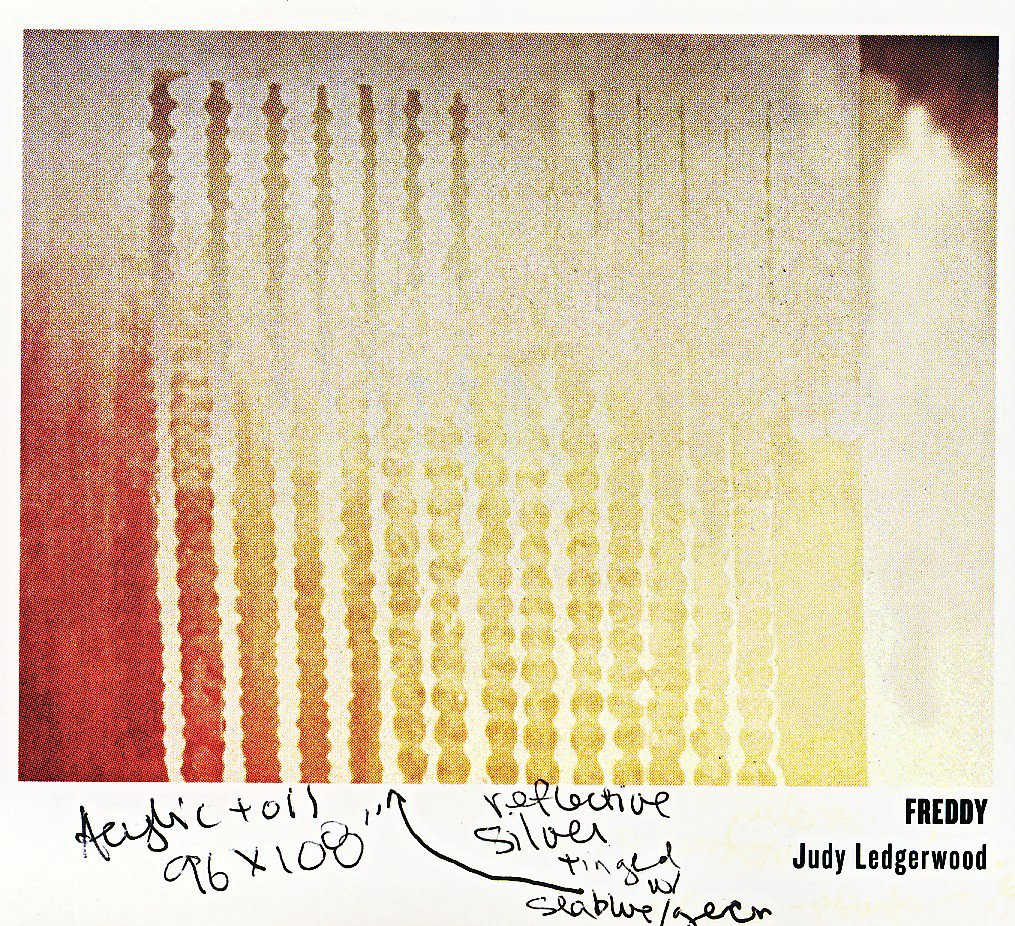
White Light is divine. It accomplishes what it sets out to do, which is to demonsrate the idea of white light as spiritual pure awareness and as an art image itself when light usually only effects the artistic final product. The appropriately named curator, Barry Blinderman, expresses the collective work best in the exhibition brochure. He states, "Light is the oldest and most pervasive visual correlate for attainment and inspiration." All notions of white light (aura, technology and otherworldly) are explored in the works presented. Natural white light is embodied in an untitled photorealistic painting by Jack Goldstein of lightening; while hot solar white light is produced by stepping an a pedal that ignites a blinding 50 light bulb installation by Gregory Green. Two 20-inch-by-20-inch paintings by Christian Garnett resemble eletric currents emitting blue hues -
blue is usually mixed with red/yellow to create electric bulb white light found in the likes of all, arguably uninspirational, color TVs. Two paintings by Susie Rosmarin, one striped and one plaid, mesh multiple spectral colors, generating far-out altered consciousnesslike white light speckles when you close your eyes after viewng. One hundred and twenty prisms, lit by the basic gallery track lighting, rotate slowly producing gentle, bubbling, ghostlike shadows of psychic white light on the gallery walls. Attending this radiantly inspired (pun intended) exhibition, perfectly suited for the Herron Gallery, will enlighten your art consciousness. Through Sept. 29, 2001; 317-920-2420, -Mary Lee Pappas
Phil Campbell "Him and Her" - Hot House Gallery - Sept. 13, 2001 - 3 stars

Campbell's latest work is probably his personal best. A bold light blue wll, demonstrating his shrewd curatorial competency, is a backdrop for 20 intimate 5-inch-by-7-inch nude black and white watercolor portraits of him and girlfriend-muse Jo. A triptych of her inspirational image carries the same rich blue hue. Some images are derived and distorted from digital photos, though they appear to be true to life. A graceful arm branches from an indefinable body and a nude fetal positioned seff-portrait is subtly and paradoxically missing Campbell's head. The clever exclusions are delicate and almost subliminal. The levels of comfort and ease with the paint application are apparent when you investigate the all-in-a-row wall of perfectly aligned tiny nudes. The richness of gray tone is parallel to the softer, more comfortable brushstrokes while the heavier, tighter lines equate to the more severe black/white contrast, The overall treatment is, by and large,dexterous and pretty impressive. Through Oct. 16, 2001; 317-686-0895. -Mary Lee Pappas
"Big White Idea" Mark Sawrie- 4 Star Gallery - Sept. 13, 2001 - 1 1/2 stars
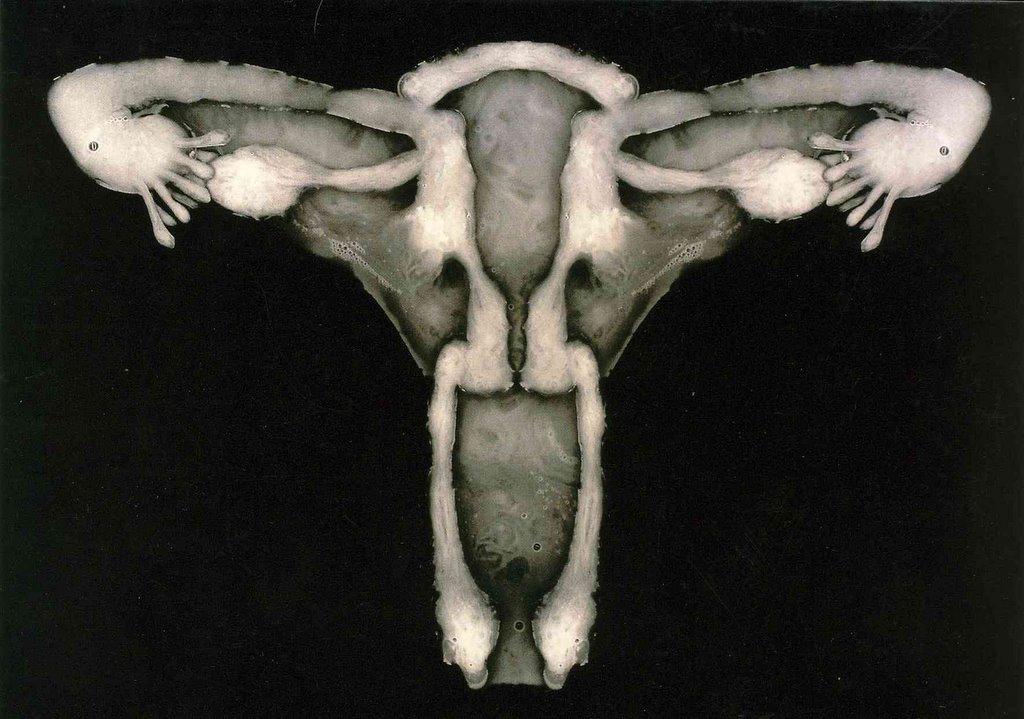
Sawrie uses digital photo techniques to enhance and manipulate his inkjet prints on canvas. The black canvas backgrounds have a soft velvet depth and seem carefully painted. These pieces are executed with practiced, perverted perfection and technical polish. The images (cynical reality meets potentially noxious internal land) are not obviously pleasing, but their disturbing energy is quite overt. They are seemingly absent of provocation and purpose. "Mad Bunny," a Bugs Bunnyish, cartoon-looking, white pigment-based (which means the artists own semen in this case), is a bore. This art is out-of-date if the intention is shock value. All images unemotionally emerge (red and white tones) from a deep void of space with a high contrast of lights and darks. Visit his website at www.moralunderwear.com to view more of his work. Closed Sept. 1, 2001. 317-636-6382. - Mary Lee Pappas
Thursday, August 16, 2001
"Sea Key" Matt Berg - Indianapolis Museum of Art - Aug. 16, 2001 - 1 star
Thursday, August 09, 2001
Delbecq Sisters - City-County Building - Aug. 9, 2001
"I See Rhythm" Michelle Wood - Indiana Historical Society - Aug. 9, 2001 - 3 stars
"Apron Strings: Ties to the Past" - Indiana Historical Society - Aug. 9, 2001 - 2 stars

One hundred aprons should demonstrate the shifting work roles of women and men over the century. Aprons traditionally have been tools of women's labor and consequently women's history, which is often overlooked - as it is in this exhibit. The aesthetic range of the apron collection is great, from ruffle-trimmed organdy and gathered tulle numbers of the to Aunt Bee bibbed styles. They hang too clustered together like campy flags of kitchen coats of arms. The collection reflects fashionable trends and some leisurely church bazaar creativity in the mid-century while overlooking most of the rest of the century (only a few examples from the early part of the 20th century are present) and is not representative of all female lifestyles. The opening exhibit script states, " Aprons are more than kitsch," and suggests ceremony and knuckle-bloody hard work, but does nothing to elaborate on how the apron, as a utilitarian protective garment, was an essential tool to the wife and unpaid domestic laborer. Kitsch is pushed in the collection and in the design of the small exhibition with its clumsy wire arched garden borders, suggesting a mythical happy whimsy. The few exhibit scripts slip sideways (you could crick your neck) in the clothespins that too cleverly hold them to the apron display forms. Women's history is represented with a much more discerning eye in other displays in the Exhibitions Gallery at the IHS. Through December 2, 2001. 317-232-1882. - Mary Lee Pappas
Thursday, August 02, 2001
"Dresden Expressions of Paul Putzki and Caroline Harrison" - The President Benjamin Harrison Home - Aug. 2, 2001 - 3 stars
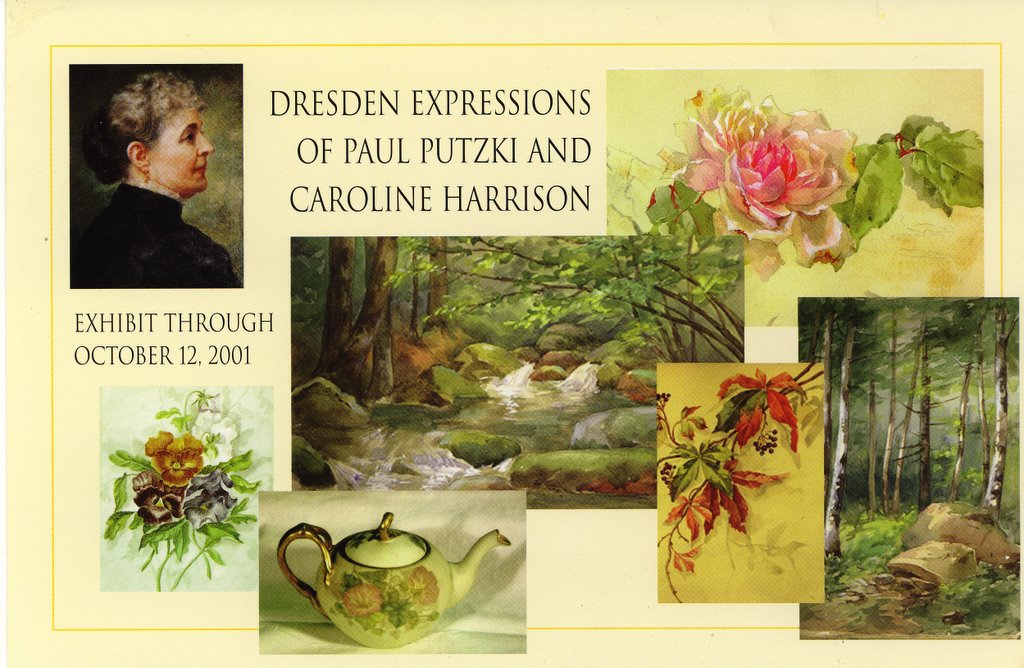
Putzki was a talented watercolorist with a school in Indianapolis were he taught the conspicuous Victorian ladies of leisure the fine art of the era - watercolor and china painting. Women, like the former First Lady Caroline Harrison, lead this fashionable Arts and Crafts hobby of the wealthy on millionaire row. True to Victorian form, Putzki and Harrison's paintings of floral blooms and sparrows are romantically realistic and accurately detailed though not quite the work of one with naturalist's sensibilities like another Victorian, Edith Wharton. Putzki followed Harrison to the White House so that she could continue her painting studies of seemingly stock suspended floral bouquets that typified the genre. Of particular beauty was a delicate and translucent image of orchids that grew in the White House conservatory. When the history of this prim epoch is explored in the Harrison home (a tour is a must to see the exhibit) alongside the wispy lifelike Valentine Day card appropriate pink cabbage rose compositions, the notable artistic talents of Harrison are vividly more apparent. Realistic nimble swabs of color, perfectly applied, effortlessly piece together idealized segments of a proper garden. Blossoms are bona fide in these floral illustrations. Through October 12, 2001. 317-631-1888. - Mary Lee Pappas
Thursday, July 26, 2001
"The Female Persona" Jack Hartigan and Michelle Pemberton - Easter Conservation Services - July 26, 2001 - 2 1/2 stars
Casey Cronin and Craig McCormick - Efroymson Gallery at the Harrison Center for the Arts* - July 26, 2001 - 3 1/2 stars
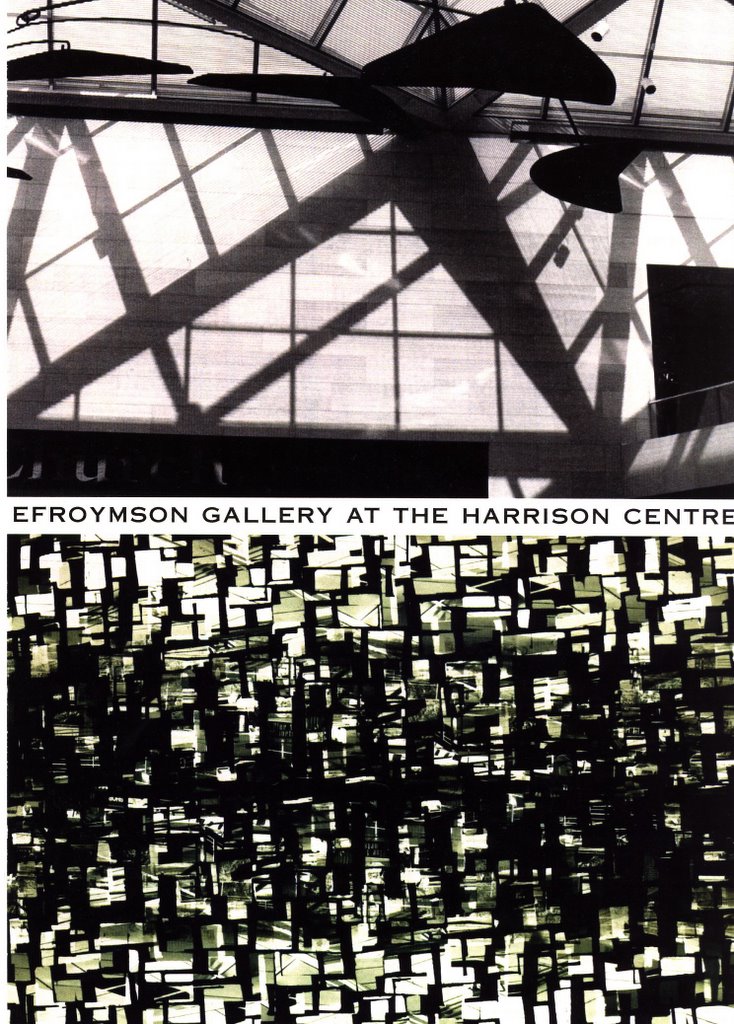
Abstract expressionism and post modernism through photography is brilliantly achieved in McCormick's work. His truly innovative images are shot through cardboard masks, and then further manipulated in the darkroom into subtle cubist renderings. Broken images of urban landscapes, sublimely colored, represent brief periods of time instead of singular split seconds typically seen in photos. Crises in his landscapes erupts, evolving in much the same way modernism did in painting. Reality is torn apart to create an illusion of the image (and the cars and things within the images) and of deep space. Technically, Cronin's work is pristine. Straightforward black and white untitled shots (mix and matchable) from European travels are artistically journalistic and rich with tone variance and a mausoleum silence. They are lonely and intimately bland. "The Laocoon Group," a full-round revolutionary Hellenistic sculpture at the Vatican Museum, is ironically photographed with some sculpture imagery negated from the cropped composition. The celebrated sculpture is spliced into a 2D isolated study. The range of grey tone beautifully defines the agony and realism of the ancient piece. Unfortunately, photo locations were not given and the architectural and sculptural subjects photographed were not named. The photos were dizzyingly displayed. They weren't hung in a coherent fashion and lost their impact split apart. Through August 31, 2001. 317-951-9610.- Mary Lee Pappas
*The Efroymson Gallery is currently the Harrison Center for the Arts Gallery at the Harrison Center for the Arts.
Saturday, July 21, 2001
Frank Glover - Durwyn Smedley's - July 21, 2001 - 3 stars
Thursday, July 19, 2001
J. David Smith - Munce Art Center - July 19, 2001 - 3 stars

Smith, associate dean of development for the Indiana School of Medicine, takes quality black and white photographs. His artist's statement says that he is inspired by "the ever changing forms and arrangements" of nature which are dissected
artistically by his camera. Local artists take note: This novice wrote a kick-butt, eloquent, well-written and understandable artist's statement. The series of photos on exhibit were all snapped during one walk in Zionsville after a memorably wicked snowstorm in 2000 - the cold miser undoubtedly being Smith's muse. The grandeur of neglected, tiny, fleeting beauty in nature takes center stage in tight compositions that make Mother Nature a Dada disciple. Ice and compacted fallen snow create natural artistic abstractions in "Ice Crystal," "Spider Ice" and "Holy Wall." There is nothing experimental or out of the ordinary with Smith's approach or technique. If I had to guess, I'd say he shot these with a trusty old Pentax K 1000. All of the shots are sharp, frozen, and perfectly exposed with studious exactitude - so much so that the f-stops and shutter speeds for each image could probably surmised as well. It is the care and honesty with which he captures his observations that make his photographs memorable. Through July 28, 2001. 317-873-6862. - Mary Lee Pappas
"Homecoming" Chip Henderson - J.Martin Gallery - July 19, 2001- 3 1/2 stars

Henderson throws narrative art out the window while bulldozing function for form in these mostly large monotone, smooth abstract, atmospheric works. They are musings of mood ripe with Zen and void of visual aversions. Far from being desolate, these subltely striped works evoke contemplative stillness with candlelight translucence. At a glance, the work of Rothko comes to mind, then vanishes upon inspection. These works are delicate. Sheer, careful rows of thinned oil make the canvases appear to be vellum. The dark crimson colors of the painting, "400 Miles," for instance, are formed and manipulated in a series of glassy layers that envelope each other like memories and shadows of our subconscious. The transparency of the paint is pushed and challenged by the infinate density of deep tones. Involuntary meditative participation is bound to occur while viewing these subliminal landscapes. Japanese paper and wax are the vehicles for earth-hued pigment in several pieces including "Hairshirt," the signature piece of the show. Through July 31, 2001; 317-916-2874. - Mary Lee Pappas
Thursday, July 12, 2001
"Sports Heroes - Two Views" James Fiorentino and Elizabeth Yorgen - National Museum of Art and Sport - July 12, 2001 - 2 stars

Thirteen true-to-life head and shoulders sports portraits by the mega accomplished James Fiorentino (23 years old) leave little to the imagination unless you are a student of watercolor. Executed deftly in watercolor, they are amazingly photo realistic and beyond perfect technically. You can see every hair on Cal Ripkin Jr.ís arm. Skin tones are rich and real, proportions are so anatomically faultless that it's no wonder Fiorentino was admitted into the New York Society of Illustrators at the tender age of 19. Images from the 1999 Topps Heritage Baseball Card series he created are on view also. In a big-time contrast are "Temple Games," four mixed media sculpture/conceptual works by Elizabeth Yorgen. Oozing glue gun goo, they comically portray basketball, hockey, baseball and football stars as "idolized in a very similar manner to the way that athletes were idolized in ancient Greece," an artists statement reads. It then makes a parallel to the Temple of Zeus in Olympia where these said athletes are were actually lapiths and the centaurs. Each piece has three humbly painted panels of athletes paired off in physical struggles (tackles and dribbles) flanked by four crude sets of wood colonnades. Could these athletes blasphemously be playing in the bastardized pronaos? Like friezes of the Classical Severe style, the scenes are dramatic, compact, and simple. A paint by numbers primary color scheme prevails as does a coloring book composition. Colors stay inside the lines with model plane precision. The pediments carry modern arena imagery flanked by 3D playing utensils: hockey puck, toy basketball hoop, you get the idea, etc. Through August 12, 2001. 317-274-3627. - Mary Lee Pappas
"Three Women Coming of Age" Patrica Rhoden Bartels, Caroline M. Mecklin, Maureen O'Hara - Hoosier Salon - July 12, 2001 - 4 stars

Patricia Rhoden (Bartels), Caroline M. Mecklin and Maureen O'Hara Pesta are three accomplished phenom female Indiana artists. Great impasto strokes of sunshine-enhanced color tease and delight the optic nerve in Rhoden-Bartels' impressionistic Indiana landscapes. The groundless compositions immerse you in dreamy, vibrant, fresh air moments full of wind and lively light. You fly through her distinctive paintings. Her work redefines Indiana art history and is nothing short of spectacular. Mecklin's prolific portraits of her beautiful daughter Libby are seductively silent and utterly feminine. Demure female forms are defined by their confident placidity - they are as much about the splendor of the female body as they are about female assurance within that body. Sweeps and streaks of sporadic and calculated colors combine to create contemporary pseudo odalisques from untraditional perspectives. Pesta's work is very poised. Her approach is less distorted and without the realistic excess or untrue vantages. Quiescent scenes are set and stories told through the precision in her exacting pastel lines. Through July 28, 2001. www.hoosiersalon.org. 317-253-5340. - Mary Lee Pappas
Christina Roberts and Lisa Pelo-McNiece - Art in Hand Gallery - July 12, 2001 -
Bam Miller - Indianapolis Artsgarden - July 12, 2001 -
Thursday, June 28, 2001
Cindy Wingo - White River Gardens - June 28, 2001 - 2 stars
Amy Falstrom - Woodburn and Westcott - June 28, 2001 - 4 stars

Falstrom's work evokes a meditative peace bemused with fantasy. Earthy, golden yellows trickle in layers over simple, analytical, animated brushstrokes. Cross-hatched, teal blues form a muddied, fertile earth ripe with June blooming flowers in "Silent Meeting." Transparent, filmy paint gradations reveal sketched petals of individual blossoms peering from the somber, sparse ground above which two bricklike feet stand - or float? A clay-toned, still waterscape, "Floating Stones," is suggestive of Monet's nympheas murals, but careful and atmospherically faery-touched. A small-scale diptych, "Little Mountains Sant Angelo," achieves depth and realism with masterful half-inch wide strokes - every brush bristle leaving a tale-telling testament to the artist's intentional yellow, green, blue and purple mountain landscape. Falstrom's warm oil paintings are illuminated with yellow hues, evoking a comfortable serenity and a spiritual tranquility. The soft gallery lighting compliments the calm mood of the work. The "Tangle" series of solitary, abstract, tangled, pseudo-organic masses breathe a life of their own. Falstrom's oil paintings, graphite and charcoal drawings are sublimely delightful. Her etchings are superb. Through July 7, 2001; (317) 916-6062. - Mary Lee Pappas

Thursday, June 21, 2001
William Austin Rent - College Ave. Library - June 12, 2001 - 3 stars
VSA Arts of Indiana Group Show - The Bungalow - June 21, 2001 - 3 stars
Thursday, June 14, 2001
Marc Jacobson - Indianapolis Museum of Art - June 14, 2001 - 3 stars
Justin Cooper - The Monon Coffee Company - June 14, 2001- 4 stars
"2001 Herron Alumni Show" Herron School of Art - June 14, 2001 - 2 stars
Thursday, May 31, 2001
"The Human Form Divine" Antonio Criscimagna - John Domont Gallery - May 31, 2001 - 4 stars
 Antonio Criscimagna's debut consists of figurative works. Criscimagna is a creator, rather than painter. Adrenalin and instinct make these unplanned paintings about basic human intimacy and companionship very effective, some more than others.
 "Remembering the Ladies: The Early Years of the Indianapolis Retirement Home" - May 31, 2001 - 1 star
Friday, April 27, 2001
April Show - April 27, 2001
This is the program from The April Show, April 27, 2001

Thursday, April 19, 2001
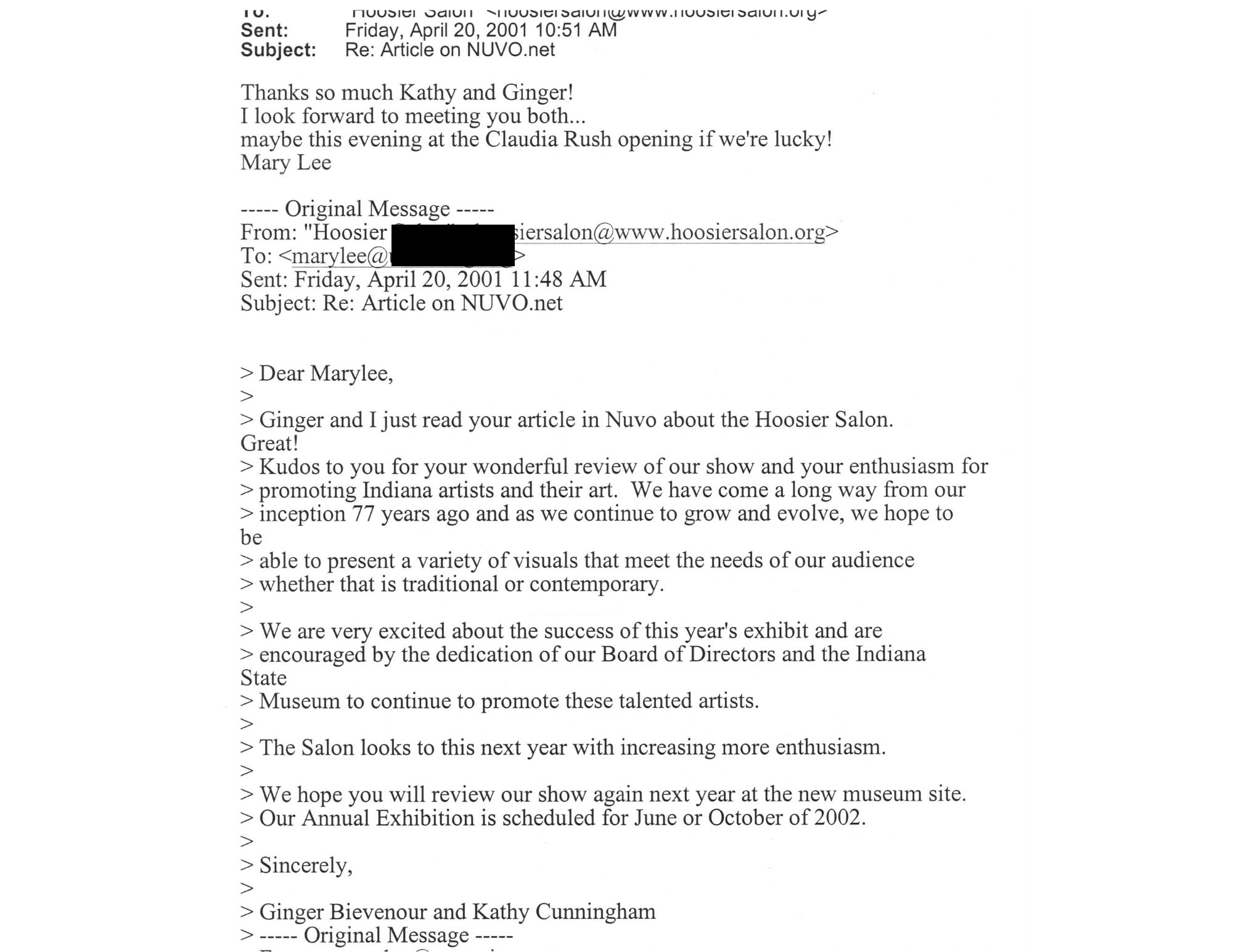
Sunsets and sunrises - 77th Hoosier Salon Annual Exibition at the Indiana State Museum - April 14, 2001



Thursday, April 12, 2001

Thursday, February 22, 2001
"Fascinating Fascination" Bill Mack - Wheeler Arts Community - Feb. 4, 2001


Thursday, February 01, 2001
Expelled From the Gardens - White River Gardens - Feb. 1, 2001


Thursday, December 14, 2000

Sherman Alexie is a normal dude for a hugely successful, young author. He wakes up late, watches TV, plays basketball, hangs out with the family and drinks too much diet Pepsi. He even had a mullet hairdo for a time. His abnormality may be his talent. “I get accused of being arrogant. That’s a word that always gets thrown in my way as if it was an insult – and it’s a compliment.“
“Every artist on this planet is an arrogant bastard. The creation of art is an arrogant process. To believe that other people would somehow be interested in your opinion of anything is arrogant. It’s hugely arrogant, so I am arrogant, but then so is everybody else. At least I’m honest about it and I’m ambitious and I’m honest about that.“
During our interview, Alexie is honest about Bobby Knight – he’s a fan. He’s honest about Indiana – “It’s extreme Bible Belt. It’s not the hotbed of intolerance. It’s the birthplace of the KKK. It’s not Wisconsin. It’s funny that a state named after Indians has a reputation for intolerance.“ He was honest about his favorite color – blue and varied derivations of blue.
Alexie's honesty extends into his works. His characters are believable people mostly Spokane and Coeur d’Alene Indian like himself. His straight narrative exposes the naïve, humble side of people – their insecurities, their quest to be true to themselves. “Everybody has that same struggle for identity regardless of their race, their culture or class. You know, Hemingway‘s white guys are struggling for their identity.“
Alexie found main stream success while breaking down popularly defined themes of the West and Indian people. He explains that what usually happens with Indians is that non-Indians represent them “whether it be painting, photography, music, movies, books whatever… they’re always portrayed as the experts and Indian artist never get that designation… we’re just the Indians. It all relates back to Indian images. Indian images have always been owned and determined by non-Indians." He describes the role famed Western artist, Remington and Russell, have had as “uncomplicated, unquestion images about what Indian is. It’s all the same damn image of that stoic, big-cheeked, big-chinned, Indian warrior and that’s still the case in mascots. We don’t get to smile!“
He goes on to say that “Pop culture has not changed its treatment of Indians very much. Tonto is still alive. The national idea of what Indians are hasn’t changed very much. I mean, there are only two kinds of Indians allowed in the national consciousness: the environmental savior or the hostile warrior. And it’s been that way since the very beginning."
A bad-guy cop reads a Tony Hillerman mystery in Alexie ‘s novel Indian killer. Hillerman's a popular non-Indian author, setting his mysteries on the Navajo Pueblo. "He writes good mysteries, but they’re pretty much Navajo 101,“ Alexie says.
Hillerman‘s fans perceive him as an expert. “I don’t think he does a whole lot to contradict that image. I’d be curious… he’s made millions of dollars writing about Navajos. I wonder how much of that money Navajos have benefited from?“
In contrast, Alexis‘s characters are complex, normal people, not generic Indians. They do not mirror or feed the stereotypes, nor do they except them. They struggle with the stereotypes.
So where can people who don’t want to be colonizers get a proper idea of history? “Stay away from anything that has spirituality associated with it." Alexie recommends turning books over to check the category. “If it says spirituality, self-help or New Age don’t read it.“ No medicine bundles from the 7-Eleven either. “Stay away from any spiritual text involving Indians, including those written by Indians.“
So what resources should someone with any interest in anything Indian turn to? Alexie rattles authors off with whippet speed, “Read fiction written by Indians. Stay away from history books." He recommends Simon Ortiz, Joy Harjo, Scott Momaday, James Welsh, Adrian Lewis, Linda Hogan, Louis Erdich.
Speaking of spirituality, we have mascots. Alexie explains that mascots shouldn’t be talked about in terms of race: (P)eople get defensive because they think they are being accused of racism and nobody wants to be accused of that, not even racist.“
He suggested mascots be viewed from a religious standpoint. “Those feathers, those beads, those songs, that warpaint… all of that is Indian religious iconography. Mascots are not racist, they’re actually blasphemous. I would think that religious organizations - you know Christian, Buddhist, what have you - would actually be on our side in this. You would never see a Catholic priest running around the floor of the gymnasium throwing Communion wafers into the crowd. It’s the commercialization of somebody’s religion. I would think that religious people wouldn’t tolerate that. I’m interested in portraying this in a more common light and trying to appeal to peoples better instincts. And the fact remains that nobody wants their religion ridiculed. They got rid of the Sambo imagery, they got rid of Frito Bandito imagery and now they have to get rid of Chief Wahoo."
I ask him what he thinks people are looking for in his work. “I have no idea.“ I say that I know they don’t get all of his jokes because I don’t get all of his jokes. “I don’t get all the jokes,“ he says downing Diet Pepsi from a liter container. When I ask him what he wants people to know about him, he gives me an arrogant, honest answer. “People are going to think what they think I have no control over that.“
Thursday, November 16, 2000
"So Long Owen Findsen, Hello Descriptivism" by Steve Ramos - City Beat - 11.16.2000
By Steve Ramos
City Beat
On one level, this column is a sincere farewell to Cincinnati Enquirer visual arts critic Owen Findsen, whose retirement from the morning daily is impending. A good-luck party is planned Friday at The Carnegie in Covington.
Now, I need to make somewhat of a disclaimer. I really don't know Findsen. We've been introduced on a few occasions, but I wouldn't refer to us as even friendly acquaintances. Still, I wanted to publicly recognize Findsen and his work at The Enquirer.
It's my hometown newspaper, too, so when the visual arts critic at the city's dominant media outlet steps down I wonder what's going to be done to replace him. I value the arts community in Cincinnati. More importantly, I'm aware how crucial it is for The Enquirer to cover the arts in a substantial and serious manner.
All of which explains my farewell to Findsen. I'm a little uneasy that the paper's visual arts critic is stepping down with no replacement in sight. My guess is that local artists and art administrators are uneasy, too.
Decisions by Enquirer editors are none of my business, of course, though I've heard that Findsen's job has been posted. But in light of the recent downsizing of arts coverage into the Sunday food section -- the result being an embarrassing section called Tempo-Taste-The Arts -- I find it hard to believe that Findsen will be replaced in a competent or professional manner.
People might find fault with the editorial assignments given Findsen -- Big, Bigger and the Biggest Pig Coverage -- but there was never any doubt about the experience and the knowledge behind his writing. Now, at a time when many daily newspapers hire critics with no knowledge of the subject they're reviewing, you have to wonder who will take Findsen's place.
"I think it's important for the public to have an experienced critic who can break it down and make an impact," says Dialogue Executive Editor Meg Galipault. "A lot of newspapers hire critics with no knowledge, and that's really a shame. Instead of getting a full understanding of the visual arts, esthetics and some kind of humanity lesson, the readers get what I call descriptivism: 'This is a painting with a blue box and the blue box sits on a green field.' "
At Dialogue, a bi-monthly arts publication focusing on Midwest artists and exhibitions, Galipault knows first-hand how important local coverage is to a city's cultural scene. She also understands the impact an arts critic can make on the local arts community.
"My experience, based on the Columbus scene, is that the local arts critic is vital to the community," she says. "They raise the profile of local artists. Granted, the level of criticism is not what it should be, but at least it's there.
"Daily newspapers have a great responsibility to the community regarding the arts. You're not going to see it on television. And if you are at all concerned about a city's cultural life, you have to report on it."
Some Cincinnati artists currently are planning a letter-writing campaign to protest the recent downsizing of The Enquirer's arts coverage. Key arts administrators hope for a personal meeting with Enquirer Editor Ward Bushee, though it's not clear what their impact might be.
As I said, I care about the quality of arts coverage in The Enquirer. Most Cincinnatians don't subscribe to Art in America or Dialogue. The New York Times covers just the New York arts community and national stories. A weekly newspaper like CityBeat can only do so much when it comes to comprehensive coverage of the visual arts community.
Like it or not, Cincinnati artists and arts institutions need Enquirer coverage. On the eve of Findsen's departure, one wonders what that coverage is going to be from here on out.
Contact steve ramos: sramos@citybeat.com
E-mail Steve Ramos