Thursday, August 16, 2001
"Sea Key" Matt Berg - Indianapolis Museum of Art - Aug. 16, 2001 - 1 star
"Sea Key," a sculpture by Matt Berg on display in the third floor of the IMA is just a little too close to the Modigliani for my tastes. The IMA has offered Berg as their current artistic talent in a monthly rotation of the finest contemporary Indiana art. This flavor of the month scrap steel and kiln formed glass piece is boring and kind of phallic. it is girder assemblage meets large-scale oven baked blue drug store craft glass. A rusty patinaed steel beam is a sculpted base for what looks like a large keyhole encased in the same rusty steel. Berg should stick to his large-scale, readily identifiable pieces that are not as design challenged. His artist statement that accompanies the piece is completely convoluted and, as an art history professor of mine in college used to say, "cosmic." Is "Sea Key" supposed to be a conceptual puzzle, or is Berg trying to make his art something it's not? His 10-ton "Bear" created for Galyans in Minneapolis is a very common image yet is wonderfully executed. The very cool brushed stainless steel Broad Ripple Village Neighborhood kiosk at College Ave. and the canal is another of his commissions, utilizing the BRNA's house row logo, to top off his construction competency. Berg is capable of more than what is displayed at the IMA. Unlike most, at least he can say he's exhibited at the IMA now. Through Sept. 2. 317-923-1331.


Thursday, August 09, 2001
Delbecq Sisters - City-County Building - Aug. 9, 2001
Whoa est moi. The devil speaks French and I know this to be true on such a sultry afternoon in the sun-savaged Circle City. My quest to clip the Delbecq duo was fruitless. On the advice of self-assurede city employee found on the other end of my Ameritech tightrope line at the City-County Building, I speed-walked through the downtown's sweaty fog air, my shirt clinging to my shoulder blades. Yes, I called the number listed in NUVO's calendar, for art voyeurs like me to call and inquire about the whereabouts of this mysterious show. In all, I made seven phone calls to three different numbers (requested the information desk twice) and spoke to nine City-County Building employees about the exhibition location. I waited 15 minutes for three different elevators (this is typical adn expected), nothing short of an amusement park ride (I enjoyed the elevator hopping), to take me to the 28th floor where I had been told the exhibit of Delbecq photos was located(seven employees didn't know what I was talking about, two directed me to the 28th floor). I found myself on the observation level among a tourism and state trinket exhibit that the cultural tourism division of our city should spend some time modernizing. What a view! What potential! And how embarrassing that children take field trips to this locale. it wouldn't take $10 million to clean it up. From this vantage, our city, on this unfathomably non-ozone day, was clouded in an ethereal nimbus of overcast conditions. I couldn't find the photos despite my a la Indiana Jones meets Sherlock Holmes investigative style. I intend to go back to the observation level and get a full tour from the lovely older gentleman who oversees that floor. - Mary Lee Pappas
"I See Rhythm" Michelle Wood - Indiana Historical Society - Aug. 9, 2001 - 3 stars
Various forms of African-American music are interpreted in the acrylic works by Wood. All of the pieces on display are originals from her book, I See Rhythm. "Jazz Women" is a piece achieved by collaging blue monochromatic action vignettes of portraits of ladies of jazz like Sarah Vaughan, together in one painting. African masked musicians carry a brilliant primary range of color as they sit among these female greats. The masked faces are a motif in many of her storytelling pieces, with unmasked faces sometimes taking on a tribal facial structure. Quick-drawn strokes of wavering, solid-colored stripes mix as they are cast across the paper canvases, creating genuinely inspired energy and adding to the atmosphere of the pieces. The paint is not pushed or overworked but is layered and easily, comfortably applied. "Ragtime" is perhaps the most sophisticated of the paintings by Wood, on exhibit with its simple flat blocks of solid color and patterns. These works effectively capture the soul of each musical style represented with a traditional African tribal aesthetic reflecting the musical derivation. Through September 3, 2001. 317-232-1882. - Mary Lee Pappas
"Apron Strings: Ties to the Past" - Indiana Historical Society - Aug. 9, 2001 - 2 stars

One hundred aprons should demonstrate the shifting work roles of women and men over the century. Aprons traditionally have been tools of women's labor and consequently women's history, which is often overlooked - as it is in this exhibit. The aesthetic range of the apron collection is great, from ruffle-trimmed organdy and gathered tulle numbers of the to Aunt Bee bibbed styles. They hang too clustered together like campy flags of kitchen coats of arms. The collection reflects fashionable trends and some leisurely church bazaar creativity in the mid-century while overlooking most of the rest of the century (only a few examples from the early part of the 20th century are present) and is not representative of all female lifestyles. The opening exhibit script states, " Aprons are more than kitsch," and suggests ceremony and knuckle-bloody hard work, but does nothing to elaborate on how the apron, as a utilitarian protective garment, was an essential tool to the wife and unpaid domestic laborer. Kitsch is pushed in the collection and in the design of the small exhibition with its clumsy wire arched garden borders, suggesting a mythical happy whimsy. The few exhibit scripts slip sideways (you could crick your neck) in the clothespins that too cleverly hold them to the apron display forms. Women's history is represented with a much more discerning eye in other displays in the Exhibitions Gallery at the IHS. Through December 2, 2001. 317-232-1882. - Mary Lee Pappas
Thursday, August 02, 2001
"Dresden Expressions of Paul Putzki and Caroline Harrison" - The President Benjamin Harrison Home - Aug. 2, 2001 - 3 stars
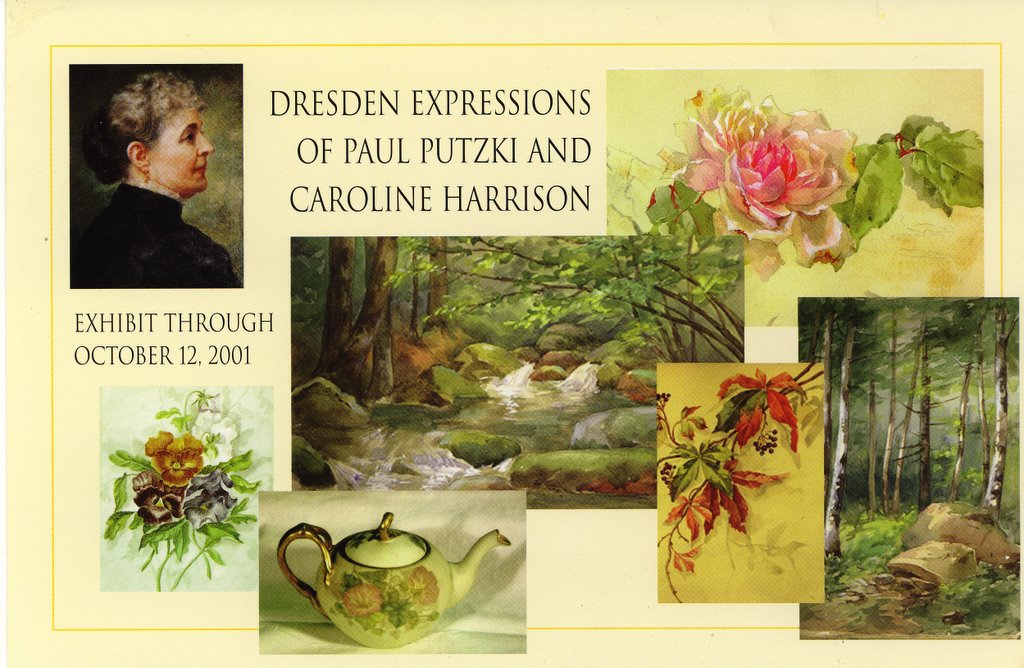
Putzki was a talented watercolorist with a school in Indianapolis were he taught the conspicuous Victorian ladies of leisure the fine art of the era - watercolor and china painting. Women, like the former First Lady Caroline Harrison, lead this fashionable Arts and Crafts hobby of the wealthy on millionaire row. True to Victorian form, Putzki and Harrison's paintings of floral blooms and sparrows are romantically realistic and accurately detailed though not quite the work of one with naturalist's sensibilities like another Victorian, Edith Wharton. Putzki followed Harrison to the White House so that she could continue her painting studies of seemingly stock suspended floral bouquets that typified the genre. Of particular beauty was a delicate and translucent image of orchids that grew in the White House conservatory. When the history of this prim epoch is explored in the Harrison home (a tour is a must to see the exhibit) alongside the wispy lifelike Valentine Day card appropriate pink cabbage rose compositions, the notable artistic talents of Harrison are vividly more apparent. Realistic nimble swabs of color, perfectly applied, effortlessly piece together idealized segments of a proper garden. Blossoms are bona fide in these floral illustrations. Through October 12, 2001. 317-631-1888. - Mary Lee Pappas
Thursday, July 26, 2001
"The Female Persona" Jack Hartigan and Michelle Pemberton - Easter Conservation Services - July 26, 2001 - 2 1/2 stars
Pemberton's "Mother's Little Helper" series, cramped in the gilding and frame restoration dream haven, is hysterical. The 1950's Betty Crocker housewife ideal is parodied in these staged stark black and white shots with high camp props and a modern look. A model, cigarette dangling from her lip, in one shot looks like a haggard moping mess ready to get gooped up for the prom - she also looks as if she's about to bust with laughter at this scenario she's in. Lucky Strikes are tucked into the huge lace-banded nylon panties of a bored Valium-popping model primping for a big night she's obviously somewhat chagrined about. Add the McCall's, prissy wallpaper, train cases and rollers and you've got a charming mythical mockery of 1950's dress-up. The "Seasons" series is soft with tea-stained tones. The overlapping dreamy images of a bouquet-headed beauty look like architectural stone embellishments. Hartigan's photos of centerfolds defaced on the wall of a downtown building, are really graceful, but boring sociological surveys. The textured, spoiled remnants of bombshell babe bedroom shots simply appear as simplistic abstract indiscernible swaps in these large pieces well juxtaposed with Pemberton's work. Through July 27, 2001. 317-507-4701. - Mary Lee Pappas
Casey Cronin and Craig McCormick - Efroymson Gallery at the Harrison Center for the Arts* - July 26, 2001 - 3 1/2 stars
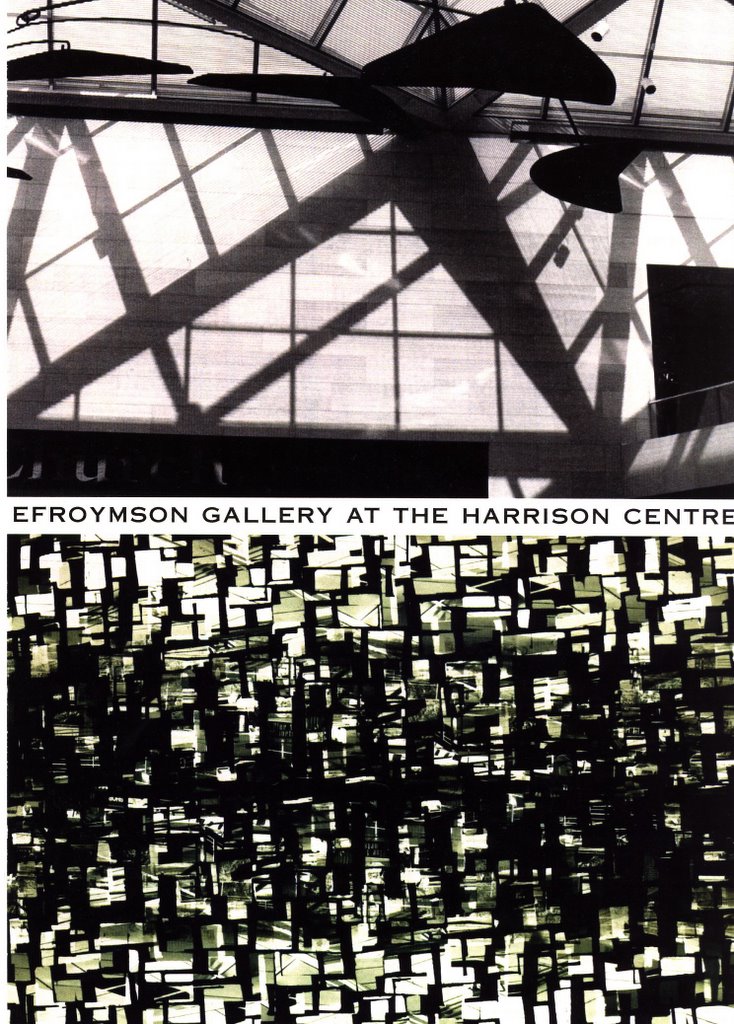
Abstract expressionism and post modernism through photography is brilliantly achieved in McCormick's work. His truly innovative images are shot through cardboard masks, and then further manipulated in the darkroom into subtle cubist renderings. Broken images of urban landscapes, sublimely colored, represent brief periods of time instead of singular split seconds typically seen in photos. Crises in his landscapes erupts, evolving in much the same way modernism did in painting. Reality is torn apart to create an illusion of the image (and the cars and things within the images) and of deep space. Technically, Cronin's work is pristine. Straightforward black and white untitled shots (mix and matchable) from European travels are artistically journalistic and rich with tone variance and a mausoleum silence. They are lonely and intimately bland. "The Laocoon Group," a full-round revolutionary Hellenistic sculpture at the Vatican Museum, is ironically photographed with some sculpture imagery negated from the cropped composition. The celebrated sculpture is spliced into a 2D isolated study. The range of grey tone beautifully defines the agony and realism of the ancient piece. Unfortunately, photo locations were not given and the architectural and sculptural subjects photographed were not named. The photos were dizzyingly displayed. They weren't hung in a coherent fashion and lost their impact split apart. Through August 31, 2001. 317-951-9610.- Mary Lee Pappas
*The Efroymson Gallery is currently the Harrison Center for the Arts Gallery at the Harrison Center for the Arts.
Saturday, July 21, 2001
Frank Glover - Durwyn Smedley's - July 21, 2001 - 3 stars
Closed July 4.
The "Window series," four acrylic on paper energetic astracts by local jazz clarinet great Frank Glover, hang clumsily by clear plastic pushpins in a little corner under two distracting shelves and above some antique knick knacks. Local galleries should be vying to represent this multitalented artist. His work complements and is a colorful and quiet einb-~diment of his music. The influence of his friend, local master Lois Templeton, obvious. Their art style, smooth suriz~ces ai)d colors, is strikingly alike. Cool golden and dirty blue hues are scratched with black charcoal into unintelligible scribble script. The improvisational motions evoke a feeling of quietioie de vivre and soul. This venue is not appropriate for such beautiful work. -Mary Lee Pappas
Connie Zeigler resources Indianapolis historic my Indiana home polis center monthly
Thursday, July 19, 2001
J. David Smith - Munce Art Center - July 19, 2001 - 3 stars

Smith, associate dean of development for the Indiana School of Medicine, takes quality black and white photographs. His artist's statement says that he is inspired by "the ever changing forms and arrangements" of nature which are dissected
artistically by his camera. Local artists take note: This novice wrote a kick-butt, eloquent, well-written and understandable artist's statement. The series of photos on exhibit were all snapped during one walk in Zionsville after a memorably wicked snowstorm in 2000 - the cold miser undoubtedly being Smith's muse. The grandeur of neglected, tiny, fleeting beauty in nature takes center stage in tight compositions that make Mother Nature a Dada disciple. Ice and compacted fallen snow create natural artistic abstractions in "Ice Crystal," "Spider Ice" and "Holy Wall." There is nothing experimental or out of the ordinary with Smith's approach or technique. If I had to guess, I'd say he shot these with a trusty old Pentax K 1000. All of the shots are sharp, frozen, and perfectly exposed with studious exactitude - so much so that the f-stops and shutter speeds for each image could probably surmised as well. It is the care and honesty with which he captures his observations that make his photographs memorable. Through July 28, 2001. 317-873-6862. - Mary Lee Pappas
"Homecoming" Chip Henderson - J.Martin Gallery - July 19, 2001- 3 1/2 stars

Henderson throws narrative art out the window while bulldozing function for form in these mostly large monotone, smooth abstract, atmospheric works. They are musings of mood ripe with Zen and void of visual aversions. Far from being desolate, these subltely striped works evoke contemplative stillness with candlelight translucence. At a glance, the work of Rothko comes to mind, then vanishes upon inspection. These works are delicate. Sheer, careful rows of thinned oil make the canvases appear to be vellum. The dark crimson colors of the painting, "400 Miles," for instance, are formed and manipulated in a series of glassy layers that envelope each other like memories and shadows of our subconscious. The transparency of the paint is pushed and challenged by the infinate density of deep tones. Involuntary meditative participation is bound to occur while viewing these subliminal landscapes. Japanese paper and wax are the vehicles for earth-hued pigment in several pieces including "Hairshirt," the signature piece of the show. Through July 31, 2001; 317-916-2874. - Mary Lee Pappas
Thursday, July 12, 2001
"Sports Heroes - Two Views" James Fiorentino and Elizabeth Yorgen - National Museum of Art and Sport - July 12, 2001 - 2 stars

Thirteen true-to-life head and shoulders sports portraits by the mega accomplished James Fiorentino (23 years old) leave little to the imagination unless you are a student of watercolor. Executed deftly in watercolor, they are amazingly photo realistic and beyond perfect technically. You can see every hair on Cal Ripkin Jr.ís arm. Skin tones are rich and real, proportions are so anatomically faultless that it's no wonder Fiorentino was admitted into the New York Society of Illustrators at the tender age of 19. Images from the 1999 Topps Heritage Baseball Card series he created are on view also. In a big-time contrast are "Temple Games," four mixed media sculpture/conceptual works by Elizabeth Yorgen. Oozing glue gun goo, they comically portray basketball, hockey, baseball and football stars as "idolized in a very similar manner to the way that athletes were idolized in ancient Greece," an artists statement reads. It then makes a parallel to the Temple of Zeus in Olympia where these said athletes are were actually lapiths and the centaurs. Each piece has three humbly painted panels of athletes paired off in physical struggles (tackles and dribbles) flanked by four crude sets of wood colonnades. Could these athletes blasphemously be playing in the bastardized pronaos? Like friezes of the Classical Severe style, the scenes are dramatic, compact, and simple. A paint by numbers primary color scheme prevails as does a coloring book composition. Colors stay inside the lines with model plane precision. The pediments carry modern arena imagery flanked by 3D playing utensils: hockey puck, toy basketball hoop, you get the idea, etc. Through August 12, 2001. 317-274-3627. - Mary Lee Pappas
"Three Women Coming of Age" Patrica Rhoden Bartels, Caroline M. Mecklin, Maureen O'Hara - Hoosier Salon - July 12, 2001 - 4 stars

Patricia Rhoden (Bartels), Caroline M. Mecklin and Maureen O'Hara Pesta are three accomplished phenom female Indiana artists. Great impasto strokes of sunshine-enhanced color tease and delight the optic nerve in Rhoden-Bartels' impressionistic Indiana landscapes. The groundless compositions immerse you in dreamy, vibrant, fresh air moments full of wind and lively light. You fly through her distinctive paintings. Her work redefines Indiana art history and is nothing short of spectacular. Mecklin's prolific portraits of her beautiful daughter Libby are seductively silent and utterly feminine. Demure female forms are defined by their confident placidity - they are as much about the splendor of the female body as they are about female assurance within that body. Sweeps and streaks of sporadic and calculated colors combine to create contemporary pseudo odalisques from untraditional perspectives. Pesta's work is very poised. Her approach is less distorted and without the realistic excess or untrue vantages. Quiescent scenes are set and stories told through the precision in her exacting pastel lines. Through July 28, 2001. www.hoosiersalon.org. 317-253-5340. - Mary Lee Pappas
Christina Roberts and Lisa Pelo-McNiece - Art in Hand Gallery - July 12, 2001 -
Closed June 30, Christina Roberts' stained glass work was nowhere to be found. Pelo-McNiece's mouth-blown glasswork was at the gallery, as publicized, and radiantly diverse while consistent in its technical excellence. Two lavender and blue iridescent pieces, dabbled with grassy green flecks, sat perfectly in the window of the c.0-op gallery, their twists and shapes looking sculpted from clay. Most intriguing was a piece that was streaked with deep cherry red and formed with thin copper wire. It had the appearance of a heart with a molten 1,.va volcano top starting to erupi. Liberal use of color powder in her glass created delicate fibrous, granular and ribbed texture patterns. Four individual petite sphere vases glowed-with solid lerhon yellow. - Mary Lee Pappas
Bam Miller - Indianapolis Artsgarden - July 12, 2001 -
Bam Miller's black pen dravvings on flimsy, stark white paper, mattec and covered in what looked like saran wrap taped together on the back, could have used a littleTLC. I readily recognized th illustrative black squiggle line portrait of drummer Jack Gilfay. 'Jimmy Goes to Mai-ket,' of Jimmy Coe, and "Four Other Brothers" were the best drawings in thebunch but that's not saying much. The pieces were stff, flat, fundamental and none. pressive, Jost in their poor presentation. Considering our city recently introduced a $10 million arts initiative, I would expect extra oomph in the level of professionalism demonstrated within the Artsgarden. The AG should have done something to a sist, improve and enhance the presentation of Miller's illustrative work. Do we want to represent the arts in Indianapolis in Such a dismissive way to the throngs of visitors traipsing through the mall? Indianapolis is all aboutjazz in July, so Miller a ac- tion portraits ofiazz musicians are absolutely apropos foe the season. But what'sthe point ~ the show is executed without care? Through July 16; 631-3301. -Mary Lee Pappas
Thursday, June 28, 2001
Cindy Wingo - White River Gardens - June 28, 2001 - 2 stars
Wingo's large, splashy acrylic paintings look as though they were executed with hesitation in her first one-woman show. There is a certain naivete in the way she puts paint (out of the tube?) to her 48-inches-by-48-inches canvases. Quality-wise, the work is unbalanced, though there is a great sense of color and shape. "Guitar" was particularly striking and crossed from the decorative to the painterly with blocks of flat, unfinished color slapped together. "Grand Piano" achieved maturity in its composition and demonstrated freedom in style. Several paintings featured scapegoat techniques: letting paint dribble heavily for no intended effect and scratching through the layers to draw something in. Overall, these works were pleasing and cheery to look at, but fell short otherwise. A predominantly white untitled piece appeared as if it had been pulled off by painting over an old piece she didn't like. Some labels about influences should have been reserved for an artist's statement. Wingo's nifty signature was consistently in the lower right-hand corner of the paintings with one exception: It fell vertically in the top right corner of one canvas making the piece look like it had been hung wrong. Through July 1, 2001; (317) 630-2001 - Mary Lee Pappas
Amy Falstrom - Woodburn and Westcott - June 28, 2001 - 4 stars

Falstrom's work evokes a meditative peace bemused with fantasy. Earthy, golden yellows trickle in layers over simple, analytical, animated brushstrokes. Cross-hatched, teal blues form a muddied, fertile earth ripe with June blooming flowers in "Silent Meeting." Transparent, filmy paint gradations reveal sketched petals of individual blossoms peering from the somber, sparse ground above which two bricklike feet stand - or float? A clay-toned, still waterscape, "Floating Stones," is suggestive of Monet's nympheas murals, but careful and atmospherically faery-touched. A small-scale diptych, "Little Mountains Sant Angelo," achieves depth and realism with masterful half-inch wide strokes - every brush bristle leaving a tale-telling testament to the artist's intentional yellow, green, blue and purple mountain landscape. Falstrom's warm oil paintings are illuminated with yellow hues, evoking a comfortable serenity and a spiritual tranquility. The soft gallery lighting compliments the calm mood of the work. The "Tangle" series of solitary, abstract, tangled, pseudo-organic masses breathe a life of their own. Falstrom's oil paintings, graphite and charcoal drawings are sublimely delightful. Her etchings are superb. Through July 7, 2001; (317) 916-6062. - Mary Lee Pappas

Thursday, June 21, 2001
William Austin Rent - College Ave. Library - June 12, 2001 - 3 stars
Rent, a Shortridge and Herron School of Art graduate, is a talented portrait painter creating crisp African-American-themed images steeped with religious overtones. His pieces are elegant and conservative much in the same vein as the new library currently displaying his work. Grace and sweetness prevail in these provincial, pretty portraits. Idealized subjects lack individual personality with straightforward, full-face poses. They are proud and expressionless - part folksy, part fundamentally formal with urban austerity. Personalities are suggested with symbols and visual clues. Features are smoothed out and sharply defined with very intentional and calculated brushstrokes. Colors are strictly true to life, though the environments of distant backgrounds are sometimes heavenly, misty and imagined. Despite, or perhaps because of, perfectionist painting tendencies, some of Rent's subjects have an off-sense of proportion. His style and technique are unquestionably his own. Through June 30, 2001; (317) 269-1732. - Mary Lee Pappas
VSA Arts of Indiana Group Show - The Bungalow - June 21, 2001 - 3 stars
Freedom and joy in the self-expression experience is evident in the furious finger marks in the clay art made by VSA program participants. My immediate reaction: VSA participants must be very at ease with their teachers because of the abandon and uninhibited independence demonstrated in their art. They feel it and create it. The Bungalow's eclectic, sleek and whimsical store environment befits the spirited show. The clustered clay masks, bowls and small people figures are, however, arranged too tightly together. An arm-locked, sitting, headless, clay people trio made with happy abandon gets lost alongside the throngs of other imaginative small figures. Of particular beauty was a hazy purple landscape executed on a small swatch (10-inches-by-10-inches) of untreated canvas; a blue structure sits on an impulsively-imagined orange-touched green foreground, flat against a lavender sky. This artist understands color. Another piece we'll call "bust of a white kitty" was very impressive as were the clay life-size, and proportionately correct masks. Nurturing self-expression with technique is freely balanced in this show. www.vsai.org. Through June 27, 2001; (317) 253-5028. - Mary Lee Pappas
Thursday, June 14, 2001
Marc Jacobson - Indianapolis Museum of Art - June 14, 2001 - 3 stars
Jacobson, a Herron associate professor, creates stock urban landscapes on paper using gesso and pastel. Some ooze jazz, while others catch a nasty funk. Fortunately, a light and fiery jazz number of the steam plant on West Street (I think) will greet you as you exit the elevators onto the third floor of the IMA. Jacobson's work ordinarily looks as though it was produced using a recipe for proportion and depth of field with a dash of color instinctively thrown in. This single piece depicting urban industrial Indianapolis was splashed with soft blues and pinks to create a chalky, furious, foggy, mundane, familiar moment in an appeasing fashion. A nasty, ugly, polluting machine aesthetically radiates with Jacobson's magical, artistic interpretation. Cool tones and smooth flowing impromptu black lines from the turn of his wrists are delicate, but ever-present. If beauty is in the eye of the beholder, teh Jacobson must be high on life. Through July 1, 2001; 317-923-1331. - Mary Lee Pappas
Justin Cooper - The Monon Coffee Company - June 14, 2001- 4 stars
Fourteen works from a 22-piece series depicting Mayan gods of thunder and rain, maize and the merchant are the latest creations from Justin Cooper. The square and diamond-textured acrylic paintings are hung together, as if they were one large piece, along the coffee shop wall. Cooper's signature subject - soft and stoic, fluid, nude women - strike kneeling, lounging and standing poses suggesting bas-relief plaques from Chiapas or Copan, while still retaining his very distinctive modern look. Random Mayan numeral symbology surrounds the blue (thunder and rain), red (maize), and grey (merchant) women and compliments Cooper's elemental patterned style, creating a fantasy world with a new cosmology. Layers of paint build up the surfaces in small strokes over rich gold underpainting, illuminating the pieces and giving them a depth that glows and shimmers under the low light of the Monon. Through June 30, 2001; 317-255-0510. - Mary Lee Pappas
Subscribe to:
Posts (Atom)